
Clinical Assistant Professor
Department of Neurosurgery
Main Line Health and Thomas Jefferson University Hospital
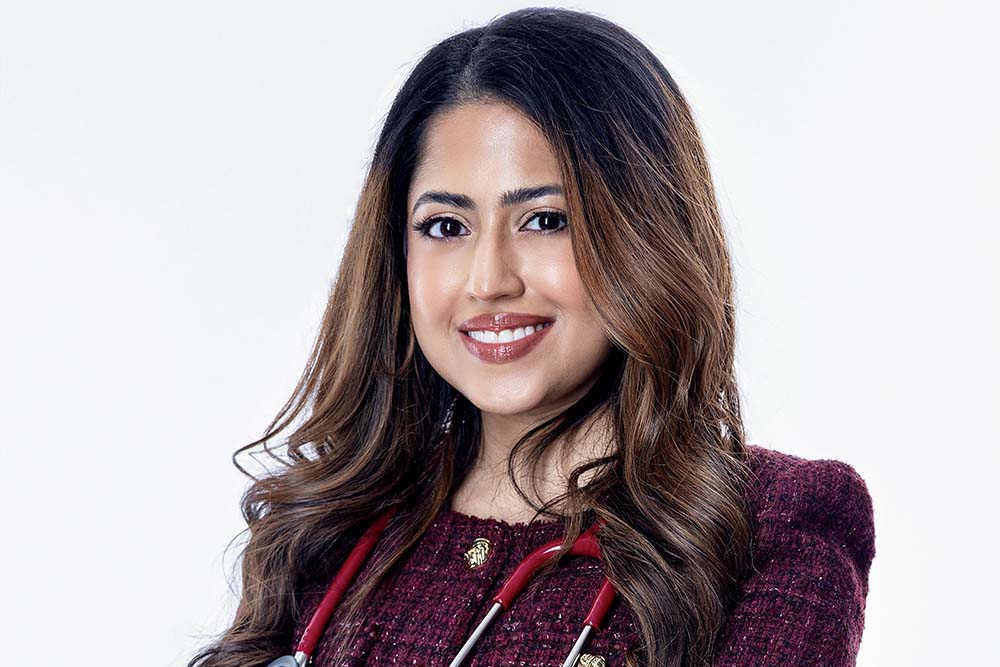
Thana N. Theofanis, MD ’14, RES ’21, FEL ’21

What steered you toward the complexities of the brain?
During my orientation week of medical school, I met Dr. Stavropoula Tjoumakaris (see pg.10), then a new neurosurgery attending — and Jefferson graduate! We immediately connected. She encouraged me to become involved in research within the neurosurgery department and more importantly fostered my early interest in the neurosciences and surgery. In many ways, her mentorship was pivotal in shaping my decision to pursue neurosurgery and ultimately guiding my subspecialty interest in cerebrovascular and endovascular neurosurgery.
What are you working on now?
In my current role, I practice primarily at Main Line Health, where I was given the unique opportunity to help build a neurointervention program at Paoli Hospital. Along with my partner, we are establishing the foundation for comprehensive stroke and vascular neurosurgical care in a strategic partnership with Jefferson Health.
This work has been especially meaningful because it addresses a critical need within the community. By providing timely access to acute neurovascular care locally, we have been able to reduce the need for patient transfers and minimize delays in treatment for time-sensitive conditions.
How do you mentally prepare for a surgery where the margins for error are measured in millimeters?
I feel fortunate to have trained in a high-volume, demanding residency program. I credit my time as a Jefferson neurosurgery resident with preparing me to independently manage complex neurosurgical cases as an attending physician.
I actively rehearse the operation in my mind, not just the ideal sequence, but potential variations. I think through where critical structures may be more or less challenging than expected, and where I might need to adapt the plan intraoperatively. Contingency planning is an important part of how I stay grounded when margins of error are measured in millimeters.
At the same time, I don’t lose sight of the responsibility that comes with these cases. The weight of it is always present, but I channel that into focus and discipline, to achieve the best possible clinical outcome for each patient.
What current advancement in neurosurgery excites you the most?
What excites me most about the next decade in neurosurgery is how rapidly cerebrovascular and aneurysm care is evolving to become more precise, accessible, and less invasive.
We are moving toward a model of care that brings advanced neurovascular treatment closer to patients, reducing the need for long-distance transfers and ensuring timely access to high-level interventions within community-based hospital systems.
At the same time, artificial intelligence is beginning to reshape aneurysm care — not only in detection, but also in risk stratification and procedural planning. This shift will increasingly support more individualized, data-driven decision-making.
What’s something people would be surprised to learn about you outside of medicine?
Outside of medicine, I grew up studying classical ballet and have always been drawn to the performing arts and theater — the discipline, storytelling, and precision behind it still resonate with me.
Becoming a mother has been one of the most meaningful parts of my life. It has made me a more thoughtful and resilient neurosurgeon. At the center of it all, my family is my world, and everything I do is shaped by that sense of purpose and connection.
Showing 3 items.