
We, as humans, are privileged to share the planet with a stunning diversity of plants, animals and even single-celled organisms. Thanks to those who study wildlife and the natural world, we know more about our non-human neighbors. This information sometimes helps books, movies, and other popular media forms represent animals and their behaviors accurately, but deeply-held historical and cultural ideas also influence how we depict animals and their relationships to humans. Researchers like Christina M. Colvin, PhD, assistant professor of writing, rhetoric and literature in Jefferson’s College of Humanities and Sciences, study human-animal relationships through multiple lenses to better understand the dynamics, impact and importance of our coexistence. Read on to learn how her research can help us understand the environmental crises our planet faces and the ways she tries to support the surrounding flora and fauna.
How Do Our Perceptions of Animals Determine How We Write About Them?
Enhancing our understanding of animals at the intersection of multiple disciplines.
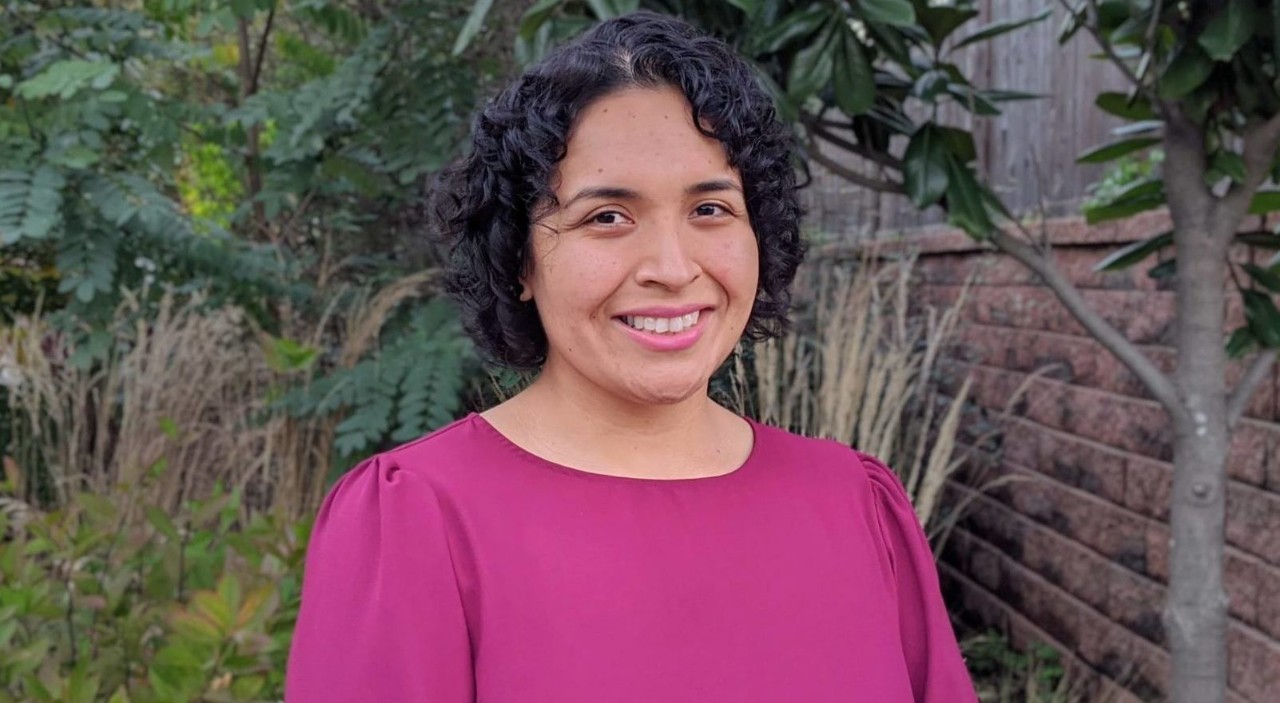
 Christina M. Colvin, PhD, Assistant Professor in Jefferson’s College of Humanities and Sciences.
Q: What is your research focus?
A: I’m so interested in the way that reading and writing about animals can make us question and think twice about what we thought we knew about them. My research centers on American literature from the twentieth and twenty-first centuries, interdisciplinary animal studies and the environmental humanities. This means that my work on representations of animals not only draws on literary studies, but also ethology, ecology, biology, philosophy, rhetoric, new media and popular culture.
Q: What’s one question you’re investigating?
A: How do the categories into which we sort animals, such as pest or pet; food or family; invasive or endangered, determine the kind of knowledge we produce about them? And, what are the (often contradictory) patterns of emotion, logic, and self-interest that inform those categories?
I also investigate how categories for animals evolve and adapt to changes in U.S. culture. For example, I analyze American author William Faulkner's fiction and how his work critiques the early twentieth-century idea that types of animals are renewable natural resources, particularly the game animals that Faulkner’s sport hunters pursued in his 1942 novel Go Down, Moses. This idea considers members of species as a lot like blades of grass: self-replicating, functionally identical and without any meaningful differences between individuals. Thinking about animals as reproducible is a concept I connect to eugenicist thinking about the heritability of human traits, or the racist idea that “desirable” or “superior” traits can and should be preserved through breeding.
If we analyze literature and science together, our insight into what animals and their loss means becomes richer, fuller and much more complicated.
Q: What first sparked your interest in your area of research?
A: The period we’re living through right now, our present, is full of difficult-to-visualize and verbalize environmental crises: climate change, mass species extinction, vast patches of human garbage in the ocean containing over a trillion pieces of plastic. As someone who analyzes writing and literary language, and who cares deeply for wildlife, I find these crises are urgent sites of study. We need both science and narrative to help us communicate the impact of environmental issues on diverse human and nonhuman communities: we need stories from diverse perspectives to feel, imagine, and just generally wrap our minds around what is at stake. In my current research, for example, I ask questions like, “How do scientists make sense of a phenomenon like a ‘species extinction,’ the ending of an entire way of being in the world? And, how do novelists write about it?” To me, neither literature nor science alone has the answer. But, if we analyze literature and science together, our insight into what animals and their loss means becomes richer, fuller and much more complicated. Bringing multiple disciplines into the conversation enables us to learn things we wouldn’t if we only studied science or only read literature.
Q: What’s a cool fact about your study subject?
A: When you research representations of animals, you get to study your subject in a lot of unexpected places. I’ve visited a stuffed, two-headed calf in a state capitol building; I’ve found a paper bag full of leopard claws in a university archive; I’ve spent hours trying to train a virtual cat to follow my commands in a video game. When you pay attention, you’ll often find animals in the most “human” of places.
Q: Many researchers have superstitions. Things they’ve done to cosmically help their experiments succeed. What are yours?
A: I’m not a superstitious person, but I do encourage the family of crows who frequent the East Falls campus to remember my face. Yes, crows are often thought to portend bad luck. But, as with so many characterizations of animals, this association strikes me as terribly dismissive. Recent studies in animal behavior show that crows are highly intelligent and can remember individual human faces. So, after years of passing near their favorite trees, I like to imagine that the East Falls crows associate me with a kind voice, a non-threatening posture. Does the possibility that I occupy a tiny corner of a crow’s memory help my research succeed? I don’t think so. Does inviting crows to look at me (just as I look at them) help me remember and write for the animal minds that comprise our shared world? Absolutely.
Q: What’s the best part of your job?
A: When you tell students and colleagues that you study human-animal relationships, they often respond by volunteering photos of their pets. And, let me tell you: the people of Jefferson have some cute pets.
Q: What’s something people would be surprised to find out about you?
A: When I see a piece of taxidermy, I just have to take a closer look. Taxidermy—mounting a dead animal’s skin—presents a fascinating instance of when artistic practice and scientific inquiry intersect. A mount can tell us a lot about how an artist conceptualizes animals, for example. What’s even more interesting to me, though, is the fact that taxidermy always calls attention to the fact that you’re looking at an individual animal who died. I think that’s part of why a lot of people find taxidermy so unsettling, even ghoulish. Seeing a mounted animal makes us look twice—and maybe even think twice—about the dynamic between humans and animals that led this animal to be preserved in this place in this pose. These interruptions to our current habits of thinking about animals: well, that’s an important part of what my work tries to accomplish.