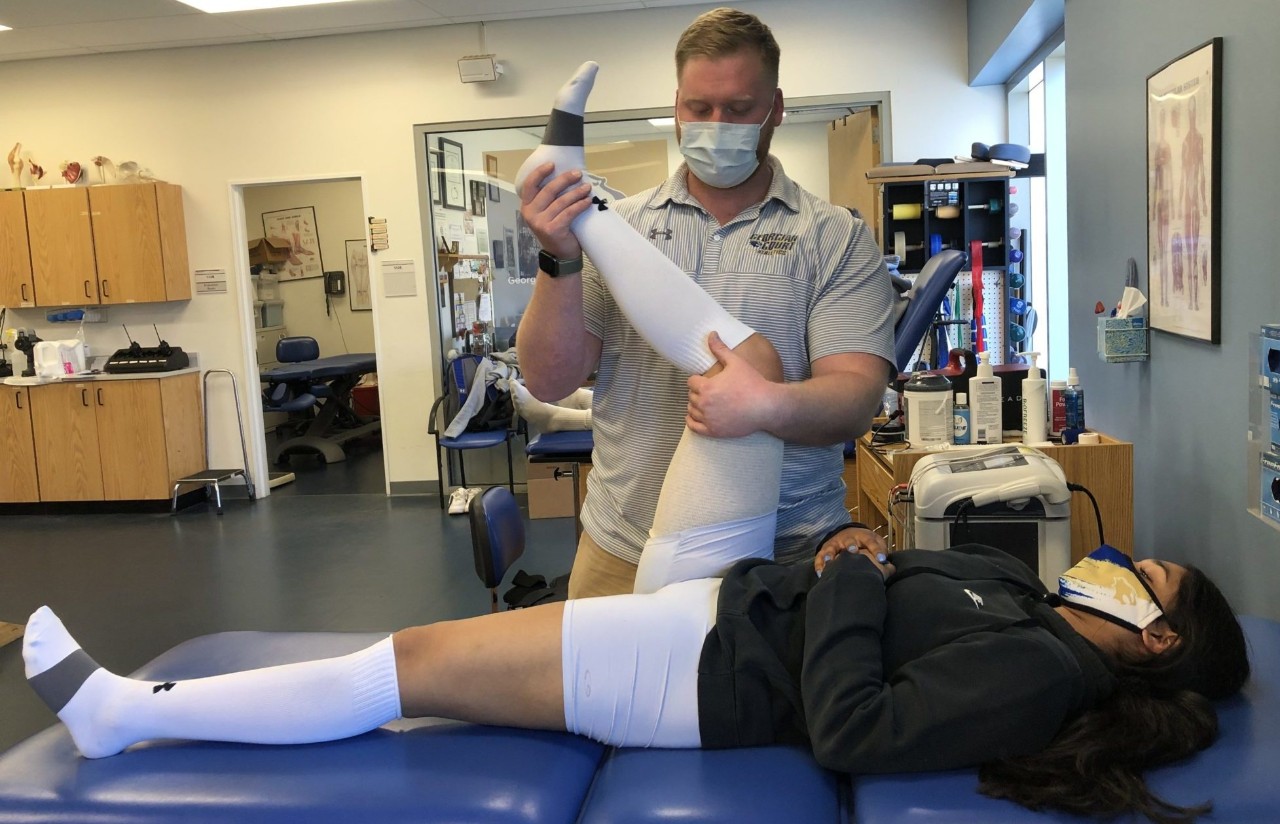

A major league pitcher can consistently throw a baseball at upwards of 90 miles per hour. An action that to the viewer’s eye lasts only a few seconds, involves the entire body and players are continually refining even at the professional level.
What Causes Range of Motion to Deteriorate in Baseball Players?
Understanding muscle adaptations in the shoulder to repetitive motion and stress.
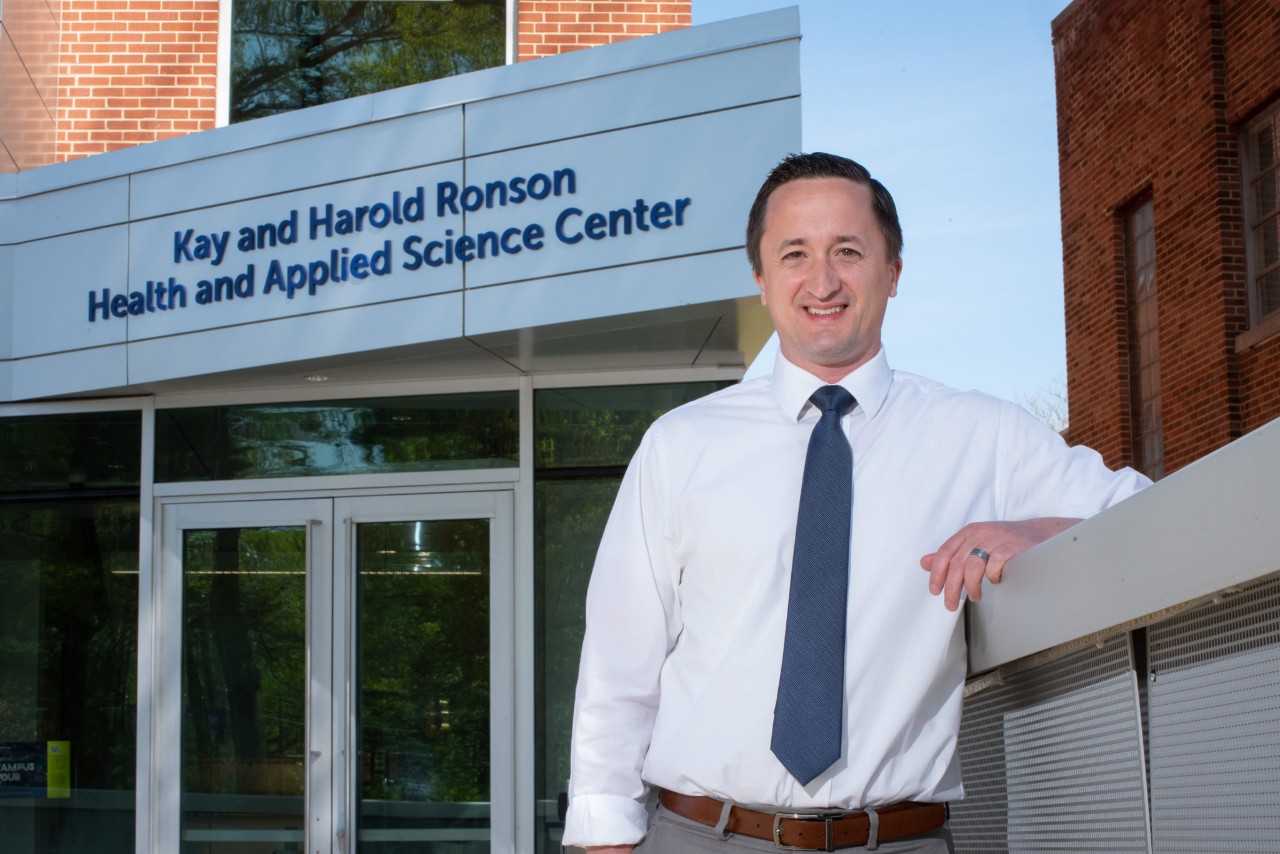 Dr. Stephen Thomas, chair of the Department of Exercise Science in Jefferson’s College of Rehabilitation Science. Photo by ©Thomas Jefferson University Photography Services.
When a pitcher releases the baseball, all the forces in the body converge together and ultimately act on the arm, which is rotating at over 7000 degrees/second -- the equivalent of the arm doing twenty 360’s in 1 second. One can imagine that over time, the pitching action produces wear and tear on the arm. Researchers like Stephen Thomas, PhD, ATC, chair of the Department of Exercise Science in Jefferson’s College of Rehabilitation Science, are studying how tissues in the arm adapt to repetitive motion and stress and lead to injury. Read more about his research below!
Q: What is your research focus?
A: The name of our lab is the ARMS Lab which stands for Adaptations to Repetitive Motion and Stress. We focus on biomechanical, neuromuscular and tissue adaptations due to repetitive motion and stress, mainly at the shoulder. We do this with overhead athletes (those who use their upper arm and shoulder in an arc overhead) like baseball players and swimmers; due to the anatomy and biomechanics of overhead positions the tissues experience greater stress. We also focus on rotator cuff repair in the general population.
Q: What’s one question you’re investigating?
A: We have been conducting several studies with baseball players to identify the adaptations responsible for the loss of internal rotation range of motion, which is very common and often linked to overuse injuries. The injuries that typically occur in the shoulder or elbow of baseball pitchers result in significant time off or require surgical intervention. With surgery it can often take a full year or more to return to the sport, and some never return to the same level of performance as before. More than 50% of college baseball players report a lifetime history of shoulder or elbow injuries, with 20% requiring surgery. There are changes in the bone, joint capsule and muscle that can account for the loss of internal rotation range of motion. We use diagnostic ultrasound to measure each of these changes and are currently researching their development and response to treatment.
Q: What first sparked your interest in your area of research?
A: I played baseball my whole life and when I started my education in Athletic Training I was instantly interested in the injuries that baseball players experienced. During my masters degree I had to conduct research and during that process I started to get what we call the “research bug.” I really enjoyed finding answers to questions that didn’t have answers. Although we usually get more questions after research studies than we do answers!
Q: What’s a cool fact about your study subject?
A: A lot of our research has involved professional baseball players. Being able to collect data on the best athletes in the world and also having the opportunity to give back to the sport of baseball is very cool!
Q: Many researchers have superstitions. Things they’ve done to cosmically help their research work succeed. What are yours?
A: I don’t have any superstitions with research. Baseball players have enough of their own!
Q: What’s the best part of your job?
A: Mentoring students is no doubt the best part of my job! I was very fortunate to have a lot of really great mentors throughout my life and I know how important those experiences were to my career. I love being able to help students find their passion and create as many opportunities as possible for them.
Q: What’s something people would be surprised to find out about you?
A: I was held back in 1st grade. My teacher suggested to my parents that it would benefit me. I know it was a difficult decision for my parents but it turned out to be a great decision. My mom runs into that teacher sometimes. She loves giving her updates about my career and thanking her for that decision.