
If you gaze upon the iconic PSFS Building in Philadelphia – now the Lowes Philadelphia Hotel – and think, ‘That’s pretty cool,’ then you might find yourself in appreciation of the city’s impressive array of modernist architecture. But valuing and preserving modernist architecture is a divisive topic – many either love or loathe the curved architecture of the former Philadelphia Police Headquarters, for example. Nonetheless, the conversation is slowly gaining momentum.
How Do We Preserve the Past for a More Sustainable Future?
An architectural historian shares her research on the challenges of preserving America’s cities.
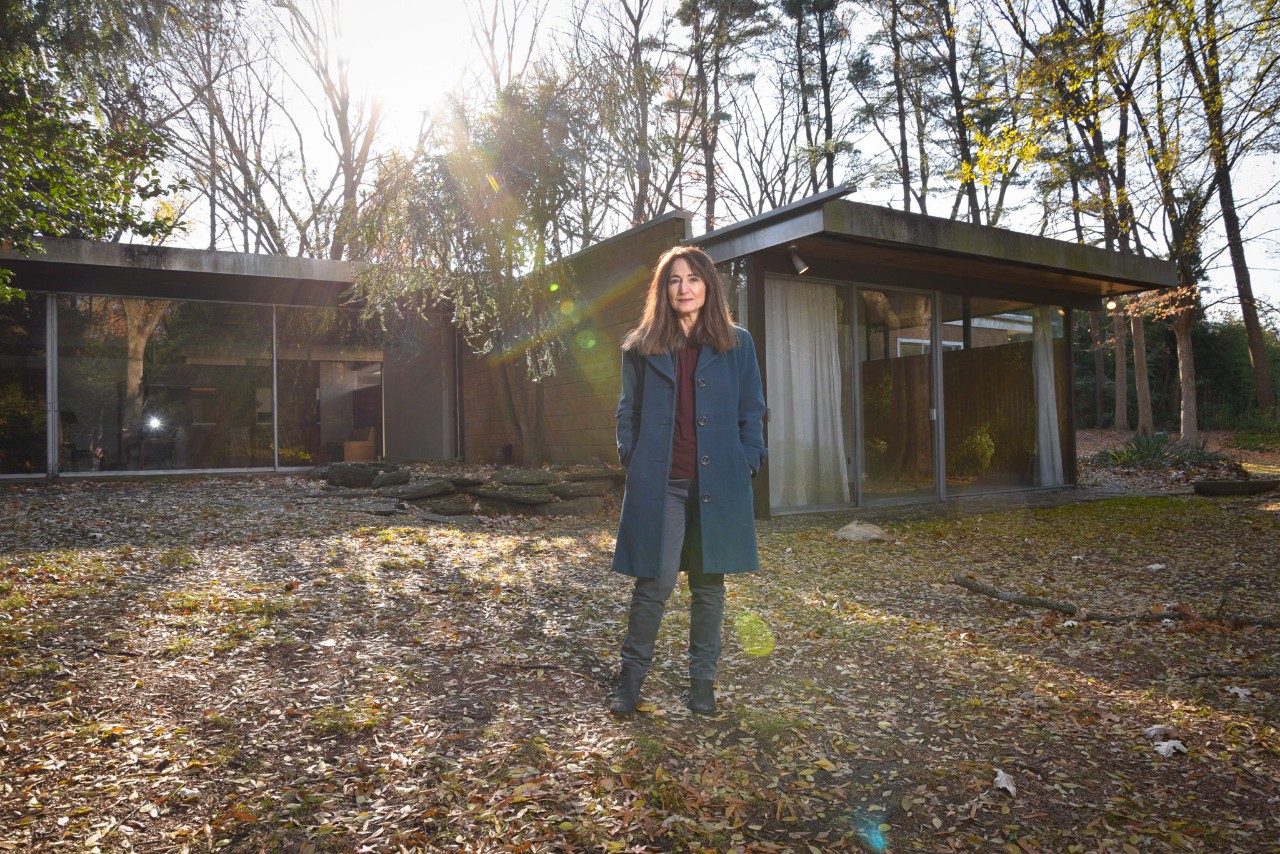 Suzanne Singletary, PhD, Jefferson’s College of Architecture and the Built Environment. ©Thomas Jefferson University Photography Services.
“Early and mid-century modern architecture is the next preservation frontier as these building stocks age,” says Suzanne Singletary, PhD, director of the MS in Historic Preservation in Jefferson’s College of Architecture and the Built Environment. This period, roughly considered to be from 1930-1980, presents unique structural challenges, while embodying distinctive social, cultural and historical significance.
Jefferson’s Center for the Preservation of Modernism builds upon the University’s legacy in architectural preservation education. The University’s East Falls campus is the home of Hassrick House, an exemplar of mid-century modern architecture acquired by Jefferson in 2017. Renowned architect Richard Neutra designed the five-bedroom, three-bath home in 1958 for local artist Kenneth Hassrick and his family. Built on a low budget and with local materials, the residence is iconic for its floor-to-ceiling windows and craftsmanship.
“By spearheading efforts to address conservation issues particular to Modernist architecture, Jefferson is taking the lead, not only in Philadelphia, but nationally and internationally,” Dr. Singletary says. “Preservation has changed from being a very insulated field, to one that is really engaged in social, economic and political arenas. It’s very exciting.”
Researchers like Dr. Singletary are interested in the conservation and the rehabilitation of the already-built environment – a “back to the future” approach that defines preserving the past as a template for a sustainable future. Find out more about the questions Dr. Singletary is trying to answer.
Q: How long have you been at Jefferson? What led you here?
A: Full-time since 2001. At that time the college and programs were in their infancy and it was great to be part of such a dynamic process.
Q: Tell us a bit about your field or area of research. What’s one question you’re exploring?
A: Most recently, I co-authored and co-edited Emergence of a Modern Dwelling: Richard Neutra’s Hassrick House, a publication sponsored by Jefferson’s Center for the Preservation of Modernism. Acquired by Jefferson in 2017, the Hassrick House (1958-61) is one of only three residences within Philadelphia designed by Neutra, internationally acclaimed architect of mid-century modernism. With its flat roof, huge expanses of window walls and interpenetrating interior-exterior spaces, the house epitomizes Neutra’s signature California style, transplanted to East Falls, Pennsylvania. My collaborator on the project, adjunct professor Suzanna Barucco, and I wanted to celebrate the incredible work of our students who curated an impressive exhibition on the Hassrick House in 2019, to mark the launch of the Center for the Preservation of Modernism and the Master’s program in Historic Preservation. Preservation of modernism is a new field as these buildings reach the fifty-year mark. As an architectural historian and preservationist, my chief goal is to raise awareness through research and advocacy.
Preservation not only celebrates our cultural heritage but also contributes to the conservation and adaptive reuse of the already-built environment as a critical defense against climate change.
Q: What first sparked your interest in your area of research/your research question?
A: Both the building and its stories were an endless source of fascination for us. Suzanna and I reconstructed the narrative of its design and construction by combing over 70 letters, exchanged almost on a daily basis, between the Hassricks, Neutra and local architect Thaddeus Longstreth. Never before published, this study reconstructs the lengthy, sometimes contentious, incubation and construction stages, giving us a glimpse into Neutra’s design process and the intense reciprocity between architect and clients. The book also documents the recollections of subsequent owners, their voices captured through archival research and oral history, to give readers a view of the house through the eyes of those who lived there.
The Hassrick House is an ideal subject to delve into the preservation issues raised by houses of this period. For example, there were several letters regarding the client’s concern that a flat roof would be subject to drainage problems. Flat roofs are a defining feature of modernist buildings, but are not an ideal form in the snow and ice of northeast winters. Likewise, window walls offer minimal insulation, a particular challenge at a time when society is focused on energy conservation and sustainability. Yet, flat roofs and large windows are character-defining features of the Hassrick House and modernism generally.
Q: What’s the fire in your belly that drives your passion for your research?
A: Above all, the book is a tribute to our students who have tirelessly researched, documented and collected story after story over the last several years. Their photographs, architectural renderings, and written words bring the house vividly to life. Emergence of a Modern Dwelling: Richard Neutra’s Hassrick House chronicles a tale of design, dwelling, neglect, restoration and reinvention today as a laboratory for learning. Best of all, this publication points the way to many future possibilities! We are planning more publications, symposia and advocacy initiatives sparked by the Hassrick House.
Q: What’s a little known or unique fact about architectural preservation?
A: Architectural preservation is often misunderstood as an effort to freeze a building in some period in time. In fact, preservation not only celebrates our cultural heritage but also contributes to the conservation and adaptive reuse of the already-built environment as a critical defense against climate change. This “back to the future” approach not only preserves but also re-envisions and re-purposes historic buildings and sites as an essential component of the sustainable cities of the future.
Q: If you had any words of advice for an aspiring researcher or student in this field, what would they be?
A: Pursue what excites you. Continue to ask questions. Realize that research can often seem to lead you in circles, but that is part of the process, and can lead to interesting discoveries that lead to more questions…and more research…and more questions…
Showing 3 items.