

Using Origami to Design More Sustainable Structures
How computational design and folding techniques are transforming architecture to save costs and cut carbon emissions.
 Yao Lu, PhD, MS, MArch, Assistant Professor of Architecture. Photo Credit: ©Thomas Jefferson University Photography Services
For centuries, architects have relied on the beauty and logic of geometrical shapes to create sound structures. This approach has led to the pyramids of ancient Egypt, large-span structures like the Pantheon in Rome, or the Arc de Triomphe in France and more modern examples such as the Oculus Transportation Hub in New York City and the Salginatobel Bridge in Switzerland.
However, all those accomplishments and an increase in the number of built structures on earth also come at a cost to the environment.
Yao Lu, PhD, is an assistant professor in the College of Architecture and the Built Environment, who uses advanced computational techniques to find new ways to build more sophisticated structures. Through his research he seeks to use innovative methods, like the Japanese folding techniques of origami and kirigami, to create lightweight, efficient and stable structures that use less materials, saving money and reducing carbon emissions in the process of construction.
Find out more about Dr. Lu’s research and the questions he’s trying to answer.
How would you describe your research to the person riding the elevator with you? What’s one question you’re exploring currently?
My research focuses on designing lightweight and strong structures with the help of emerging computational technologies. Instead of relying on high-strength structural materials, I design structures that provide strength through their geometries. For centuries, builders have been using this approach for creating large-span structures like arches and domes. Nowadays, advanced computational techniques allow us to create even more complex and efficient shapes. They help reduce material usage and make it possible to use modest non-structural materials for structural purposes.
The research question I am currently working on is using flat thin sheet materials, such as metal sheets, wood panels and paper composites, to create efficient and stable spatial structures through origami folding techniques and kirigami, a variation of origami that involves cutting and folding. The 2D to 3D transformation allows us to take advantage of both configurations and reduce both material cost and energy consumption during fabrication and construction. The 2D flat configuration is usually easy to process using various computer-aided manufacturing techniques such as laser-cutting, CNC milling and plasma cutting. The flat parts can be packed compactly for transportation. Once onsite, they can be folded into 3D configurations to gain structural strength.
-

Yao Lu demonstrates how the model bridge is made of individual units. Photo Credit: ©Thomas Jefferson University Photography Services
-

Yao Lu demonstrates how the model bridge is made of individual units. Photo Credit: ©Thomas Jefferson University Photography Services
-

Yao Lu demonstrates how the model bridge is made of individual units. Photo Credit: ©Thomas Jefferson University Photography Services
What problem does your research try to solve?
My research aims to tackle the significant environmental impact of the construction industry, with a particular focus on building structures, which account for a substantial portion of carbon emissions and energy consumption. By developing efficient structural forms and exploring innovative construction methods, my work aims to reduce material use, minimize waste and lower carbon emissions.
What first sparked your interest in your area of research?
I’ve been interested in structural design since my undergraduate studies, but one project truly solidified my dedication. During my master’s program, I visited the 2016 Venice Biennale and encountered the Armadillo Vault, a large-span structure made of 399 unique limestone pieces, assembled without reinforcement. Spanning 16 meters with a minimum thickness of only 5 cm, it demonstrated the immense potential of structural geometry. I witnessed how form alone could create stability and strength. It was inspiring and deepened my commitment to exploring innovative structural design.
 Yao Lu building Tortuca, a three-meter-span prototype glass bridge. Photo Credit: Polyhedral Structures Laboratory
What is the best memory you have from conducting your research?
One of my most memorable research experiences was testing a structure to failure. Nothing can teach us more than pushing a structure to its limit and observing how it fails. During my PhD at the University of Pennsylvania, we built a three-meter-span prototype bridge from standard float glass. Given glass’s brittleness, no one trusted the bridge fully, despite simulations showing it would hold. Only after load testing to failure did we see its true capacity; it withstood a weight equal to seven adults at its weakest point.
What’s a unique fact, surprising statistic, or a myth about your study subject?
Geometry is extremely powerful in structural design. Using optimized geometries lets structures stay thin while still being strong. The Cosmic Rays Pavilion in Mexico City, built in 1951, uses a paraboloid shape to span 40 feet with a maximum thickness of just 5/8 inch, making it one of the thinnest reinforced concrete shells.
-
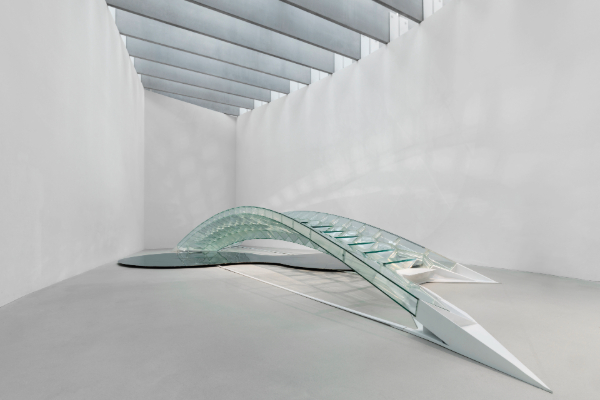
The 10-meter-span glass bridge, developed by a research team at the University of Pennsylvania, is currently on display at the Corning Museum of Glass through September 1, 2025. Yao Lu has been a core team member on the project since his PhD studies and continues this line of research at Thomas Jefferson University. It consists of over 130 hollow glass units. Photo Credit: Corning Museum of Glass. Full project and exhibition details: https://psl.design.upenn.edu/project/ultra-thin-high-performance-glass-bridge/ and https://whatson.cmog.org/exhibitions-galleries/glass-bridge-clear-path-sustainability.
-

The 10-meter-span glass bridge, developed by a research team at the University of Pennsylvania, is currently on display at the Corning Museum of Glass through September 1, 2025. Yao Lu has been a core team member on the project since his PhD studies and continues this line of research at Thomas Jefferson University. It consists of over 130 hollow glass units. Photo Credit: Corning Museum of Glass. Full project and exhibition details: https://psl.design.upenn.edu/project/ultra-thin-high-performance-glass-bridge/ and https://whatson.cmog.org/exhibitions-galleries/glass-bridge-clear-path-sustainability.
-

The 10-meter-span glass bridge, developed by a research team at the University of Pennsylvania, is currently on display at the Corning Museum of Glass through September 1, 2025. Yao Lu has been a core team member on the project since his PhD studies and continues this line of research at Thomas Jefferson University. It consists of over 130 hollow glass units. Photo Credit: Corning Museum of Glass. Full project and exhibition details: https://psl.design.upenn.edu/project/ultra-thin-high-performance-glass-bridge/ and https://whatson.cmog.org/exhibitions-galleries/glass-bridge-clear-path-sustainability.
What’s something you’re passionate about outside of your research?
Long-distance running. It’s a great way to stay fit and maintain high energy and endurance. Philadelphia offers numerous running events throughout the year, which keeps me motivated to train regularly. Plus, carb-loading meals before a race is a fun excuse to enjoy good food guilt-free.
Who’s a role model or someone who shaped your journey? Is there a piece of advice that stuck with you or that you try to pass on to young researchers?
I was fortunate to have excellent advisors and colleagues during my time at Cornell and UPenn. All of them were incredibly insightful and supportive of my journey. As a young researcher myself, I try to follow the most valuable advice they’ve given me: to be patient and persistent in research. Challenges and setbacks are a part of the process, and it’s through steady persistence that meaningful progress is made.
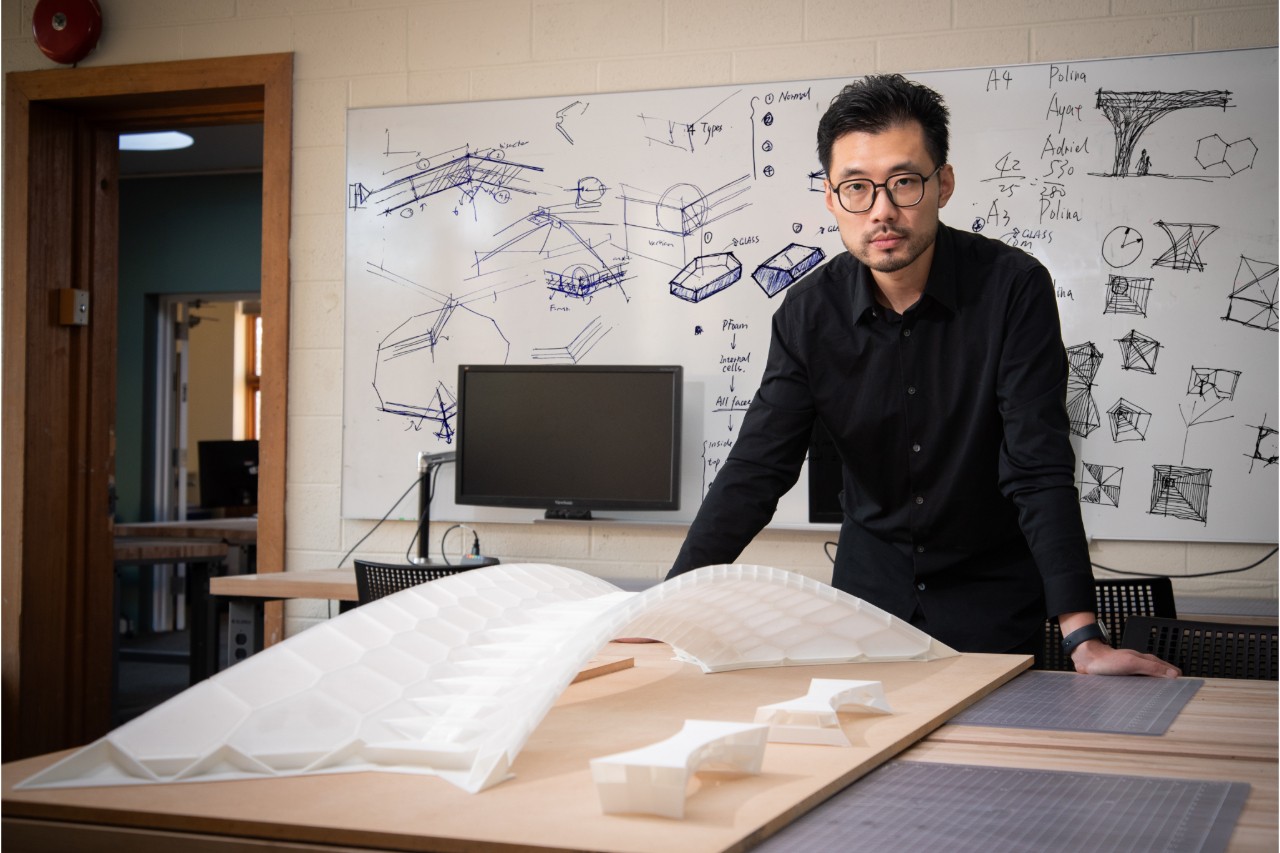 Yao Lu poses with his models and renderings. Photo Credit: ©Thomas Jefferson University Photography Services


