

Supported by data and smart technologies, smart cities is an emerging paradigm in the development of urban environments in an attempt to build more efficient, healthier and livable cities. It’s the intersection of the built environment (urban planning, infrastructure, buildings, recreational spaces), population health (public health, environmental issues) and technology. Integrated in buildings and city systems, sensors and controls monitor all aspects of life and are set to transform the urban landscape.
How Can Researchers Contribute to Designing Cities That Will Be Efficient, Healthy and Resilient?
Designing the future of sustainable architecture today.
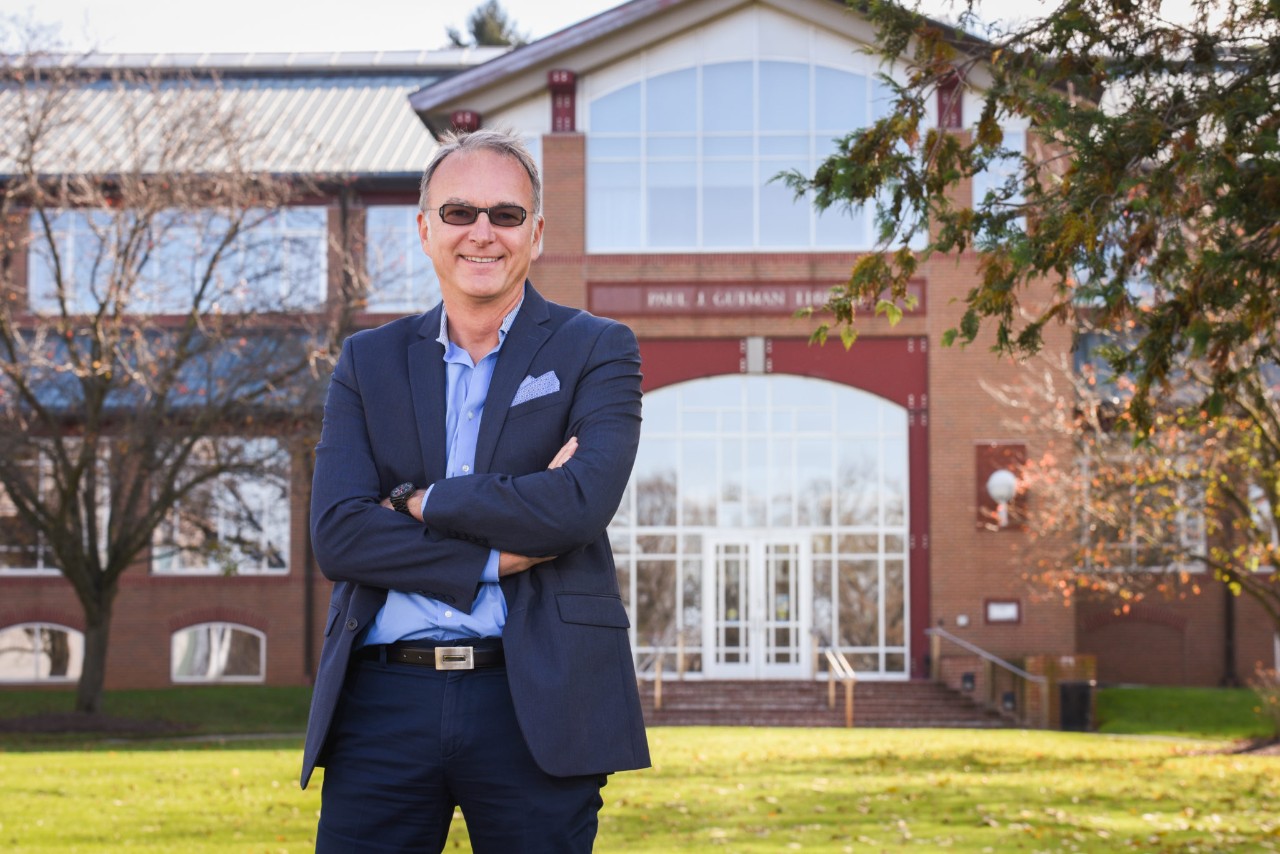 Edgar Stach, Professor of Architecture at Jefferson’s College of Architecture and the Built Environment.
Researchers like Edgar Stach, professor of architecture at Jefferson’s College of Architecture and the Built Environment and member of the Kanbar College of Design, Engineering and Commerce, are working on developing sustainable architecture. Find out more about Professor Stach’s research and the questions he’s trying to answer.
Q: What is your research focus?
A: As a licensed architect with 25 years of experience in city planning, building design and high-performance building technologies, I focus on architectural solutions embracing efficiency, ecological sensitivity and responsibility. My working model combines practice, teaching and research.
My current research centers on new developments, innovative techniques and advanced technologies in architecture for advanced energy-efficiency. Today, rapid urbanization driven by economic growth and employment opportunities create environmental, social and health challenges in cities around the world.
Some of the adverse effects of overpopulation can be seen in traffic congestion, air pollution, street noise and disappearing bio-diversity and natural landscape. In future cities, electric and driverless cars will free up and repurpose obsolete infrastructure into increased bike lanes and pedestrian pathway networks, green infrastructure to increase public health and the quality of life.
Developing a range of smart and innovative solutions to achieve more sustainable and healthy living conditions is crucial to improve health and well-being.
Q: What’s one question you’re investigating?
A: I once served as program manager for energy efficiency and building efficiency for the King Abdullah City for Atomic and Renewable Energy (K.A.CARE) in Saudi Arabia. You could ask the question: why is Saudi Arabia going green when they have so much fossil fuel? And the reason is that they see that the world is going to go green and they want to capture that technology, so they heavily invest into solar fields, green desalination and hydrogen production.
Rapidly urbanizing cities are centers for innovation and prosperity, but cities also significantly impact the environment and their inhabitants. The urban environment is a complex interwoven system of different factors, all affecting human health and well-being. A better understanding of these linkages and effects provides the necessary insight to plan future actions and solutions for health-centric urban planning. In my research, I am interested in smart and healthy cities and how to enhance quality of life by addressing architecture, health, energy transportation and utilities.
Q: What first sparked your interest in your area of research?
A: Starting early on in my professional career, I embraced the slogan “form follows evolution” and sustainable architecture.
At the beginning of the last century, Louis Sullivan created the slogan “form follows function,” based on the esthetic of machines and engineering. Pollution, energy consumption, overpopulation, rising world temperature, etc. are critical keywords for this century. As architects, we are the interface between civilization, science, technology, industry, and architecture. Evolution in biology means that everything is in balance and perfectly adapted. For me as an architect, form follows evolution means that architecture has to be as successful as nature.
In my design philosophy, “form follows evolution” ecologically includes the principles of efficiency, simplicity, synergy and beauty, this means architecture has to be ecologically sensitive and in equilibrium with nature – this creates beauty.
Urban development and architecture are largely responsible for land conversion and habitat loss, disappearing biodiversity, global warming or climate change, pollution and contamination of our air, land and water. Sustainable architecture is paramount in reversing these negative trends and benefits everyone.
Q: What’s an interesting fact about your study subject?
A: Energy is our most precious global resource and buildings are the largest consumers of energy. As architects, we are at the center of decision-making in this arena and play a key role in saving energy and making buildings more efficient and even capable of generating energy.
Q: Many researchers have superstitions. Things they’ve done to cosmically help their research work succeed. What are yours?
A: Staying engaged, accepting different perspectives, believing in science and facing the most critical challenges. Most importantly, being human-centric.
Q: What’s the best part of your job?
A: The ability to collaborate and teach cross-disciplinarily across Jefferson’s colleges, work with amazing faculty and connect through Jefferson’s global network with the leading experts around the world.
As director of the new Thomas Jefferson University Institute for Smart and Healthy Cities, I look forward to collaborating with experts across the campus – as well as our students – to respond to current socio-economic and ecologic pressures. My vision is to transform urban environments into smart and healthy cities through learning, innovation, teaching, research, industry partnership and community engagement.
Q: What’s something people would be surprised to find out about you?
A: I like to cross the European Alps on a mountain bike. The last ride was with my wife, Barbara Klinkhammer, and took nine days from Garmisch-Partenkirchen in Bavaria to Riva de Garda in Italy across the German, Austrian, Swiss and Italian Alps.