
In 2015, a protest movement called #RhodesMustFall started at the University of Cape Town in South Africa. It called for the removal of a statue of Cecil Rhodes, a controversial figure of British imperialism and colonization in southern Africa, but also the transformation of curriculum, teachers and environments at the university to better represent, reflect and respect Black African students and scholarship. The movement spread beyond the African content to Europe, the U.S. and Latin America, eventually culminating in a conference a year later called “Decolonizing the Academy” which called for an examination of how knowledge and power are defined and distributed in African Studies.
How Do We Decolonize African Studies?
Creating a database of and elevating scholarship produced by African researchers.
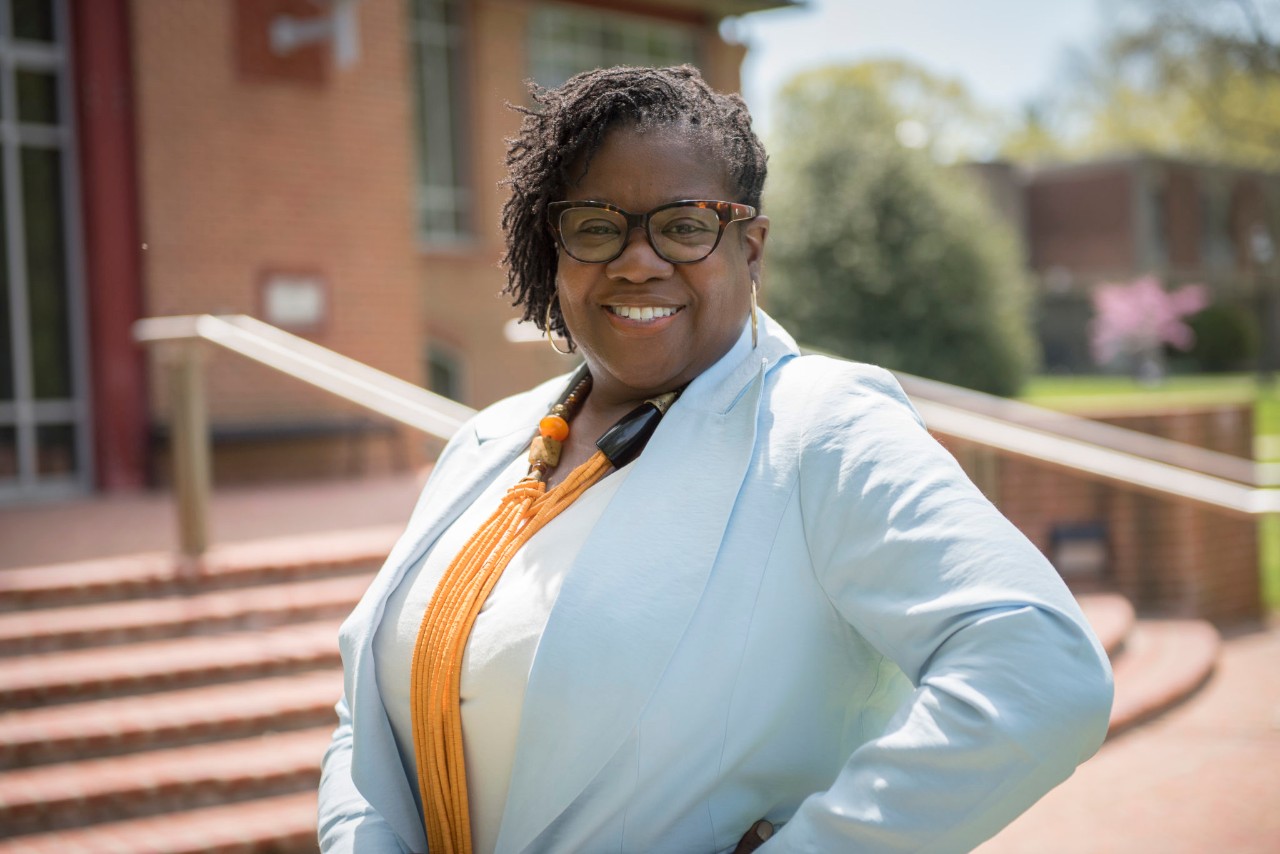
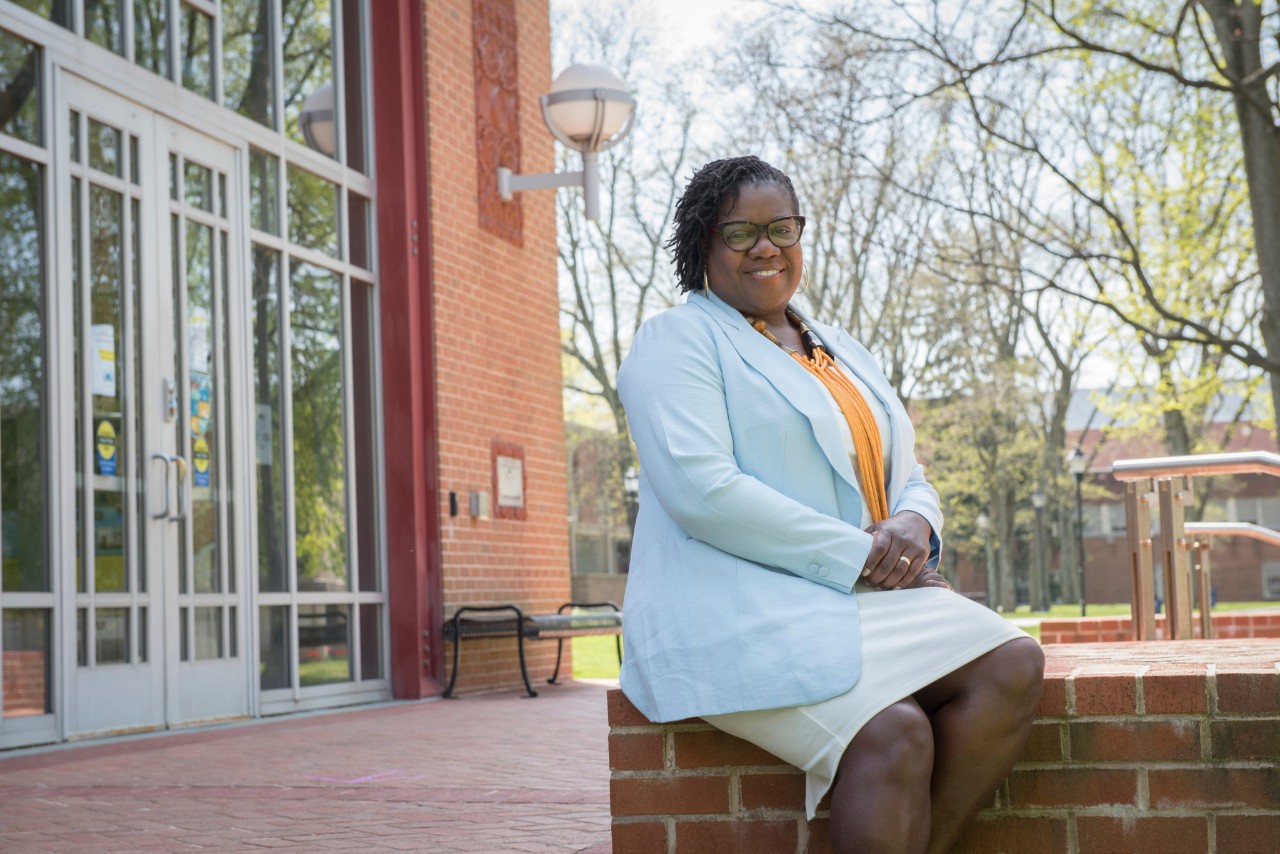 Dr. Marcella McCoy-Deh, Associate professor of American Studies and Director of the Honors Institute.
Marcella McCoy-Deh, PhD, associate professor of American Studies in Jefferson’s College of Humanities and Science, dedicates her research to building concrete steps to decolonize African scholarship. Currently, she is exploring how to ensure that students of African Studies learn about the African experience with materials from African scholars, as opposed to curricula that are dominated by European and/or colonial perspectives. Read on to learn more about her vital work.
Q: What is your research focus?
A: In general, I explore African American Identity Affirmation, that is, self-presentations that are unique outgrowths of the African American experience. My doctoral research looked at the folk culture of African American fraternities and sororities or Black Greek Letter Organizations, which originated at the turn of the 20th century when Blacks were not permitted to join honors societies or reside on campus at many predominantly white institutions (PWIs). Further, upon graduation many Black students could not find work in their professions of interest. While the organizations developed official practices and procedures, they became identifiable decades later by their unofficial, but highly visible and in some cases unsanctioned, traditions.
More recently, my work has focused on the nuances of navigating African American identity in modern spaces where respectability politics (the idea that marginalized groups must conform to mainstream standards of appearance and behavior in order to receive better treatment and protection) persist, usually as a result of complex and intersecting cultural identities of ethnicity, class, race and socio-economic status. This work has shown up in my creative writing projects, The Search for Susu (2015) a novel about coming-of-age in academia in which the main character finds her way as a Black, female, PhD (co-authored with Tracey Lewis-Giggetts) and The Akofa Stories (2016), about a child with a traditional African name. I authored this book to help children with names traditional to their country of origin confront what they would undoubtedly face in the United States as adults and peers when asked to shorten their names or use nick names that are more familiar to them.
Q: What’s one question you’re investigating?
A: Currently, I have a project called “Africa in First Person: Circulating with Centrality,” which aims to create a repository of abstracts by African Studies scholars. The repository would invite scholarly submissions 1) that were rejected by Western journals for lack of deference to Western ideas; 2) that address damaging mis-steps and misinterpretations that preference Western academic dominion in African scholarship.
This project was conceived during my 2019-2020 Fulbright year with the Institute of African Studies (IAS) at the University of Ghana (UG) - Legon. Many of the readings assigned to students in courses I was assigned to help teach at the Institute addressing topics on slavery and colonization within Africa were authored by European scholars. While African scholars are and have been productively conducting research, publishing, and teaching, per established best practices, many faculty are compelled to teach "founding" scholarship, often authored by European scholars. In many situations, faculty spend significant time and effort deconstructing misinterpretations, omissions and simplifications on the part of the authors in order to resituate the content and context for students.
Consultation with faculty colleagues in IAS at UG confirmed that promoting the repository as a resource for editors, researchers and students for materials on the African experience by African scholars is a fresh approach. The African Studies scholars I consulted believe in the project’s capacity to contribute to efforts to decolonize the academy – pointing out potential to informing curricula, stating “who writes about what and from where” is as important as the content.
Q: What first sparked your interest in your area of research?
A: The topic of decolonizing African scholarship underpinned or was overtly addressed in almost every course and conference in which I participated. Academic colonization of scholarship on African experiences not only extends the occupation that decolonization of Africa sought to abolish, but it also marginalizes African scholarship to African journals. Broadly, this practice diminishes access by the global scholarly community to valuable perspectives that could serve to elevate our competency of African cultures, experiences and history. Also, this marginalization can prove prohibitive to promotion and tenure for African scholars expected to publish in international/ intercontinental journals.
Q: What’s a little known fact about your study subject?
A: There are African Studies publications based at African universities. Unfortunately, these “local” journals are not always published regularly. They are also not accessible on international databases such as JSTOR, Google Scholar, etc. As a result, the African Studies scholarship that is produced in Africa can be difficult to access by researchers and students. Besides, a generation of comparative scholarship by African researchers is lost due to a lag in access to academic publishing.
Q: What’s the best part of your job?
A: Contributing to the positive development of students realizing their potential and positioning themselves to actualize their goals and dreams. With respect to me, it’s the research - the discovery of it all; filling in knowledge gaps; hosting conversations from different perspectives.
Q: What’s something people would be surprised to find out about you?
Once upon a time, I wanted to be an airplane pilot and a war strategist. Long family road trips as a child sparked my interest in discovery through travel. As the youngest of five, I developed a sharp lens on social justice in my own little world. I think those goals were early manifestations of my need to control my movements in all spheres of life and to help others fighting to do the same. I suppose that’s also the link to my work on decolonization.