
If there is one undeniable byproduct of the COVID-19 pandemic, it’s the way telehealth is transforming how medicine is practiced. Early in the COVID-19 pandemic, telehealth usage surged as consumers and providers sought ways to safely access and deliver health care. In April 2020, overall telehealth utilization for office visits and outpatient care was 78 times higher than in February 2020. Telehealth has offered a bridge to care, and now offers a chance to reinvent virtual and hybrid virtual/in-person care models, with a goal of improved healthcare access, outcomes and affordability.
How Do We Break Down the Barriers to Telehealth?
Utilizing education, training and research to usher in a new era of health care.
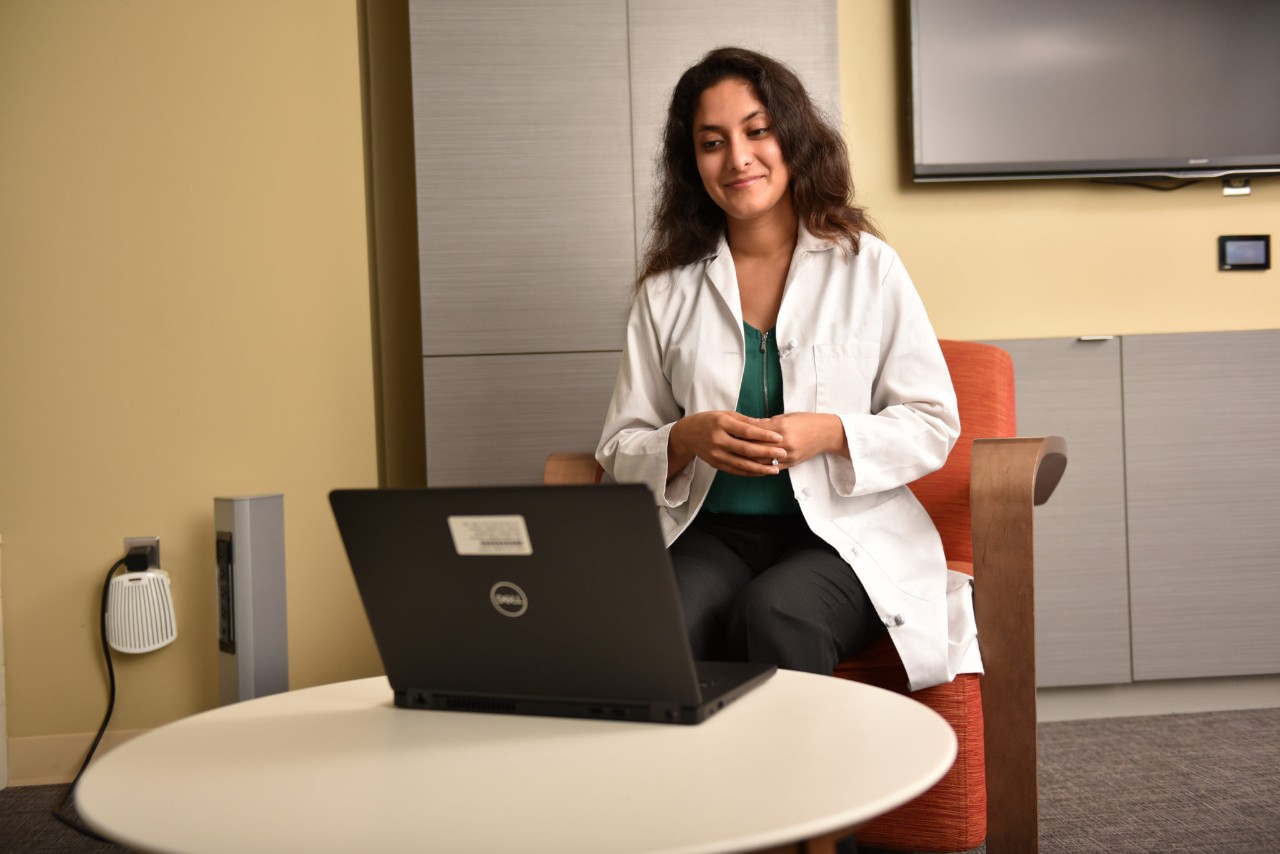 Shruti Chandra, MD, of Jefferson’s Institute of Emerging Health Professions and assistant professor in Emergency Medicine in Sidney Kimmel Medical College. ©Thomas Jefferson University Photography Services
“Telehealth is going to lead to more home-based health care,” says Shruti Chandra, MD, program director, Digital Health and Telehealth Facilitator Certificate in Jefferson’s Institute of Emerging Health Professions. “It’s going to change the way we think about physical exams and a doctor’s role in the healthcare system.”
Researchers like Dr. Chandra are helping to establish a new age of telemedicine, by providing education to physicians. Find out more about Dr. Chandra’s research on how to make this education more effective, thereby helping physicians overcome barriers to telehealth.
Q: How long have you been at Jefferson? What led you here?
A: I have been at Jefferson for over 13 years, as I completed medical school, emergency medicine residency and medical education fellowship at Jefferson before continuing on as faculty.
Q: Tell us a bit about your field or area of research. What’s one question you’re exploring?
A: My research focuses on education in the various areas that I work in – this includes medical simulation, telehealth and digital health, undergraduate medical education and diversity. Currently I am studying telehealth education for medical assistants (MAs), who usually take medical histories and record vital signs of patients. The research aims to define and expand upon the role medical assistants can play in the healthcare team, through the lens of telehealth. We are gathering information about current telehealth practices and if or how MAs are empowered to advocate for telehealth in their professional settings. The study is also examining the effectiveness of a five-week online telehealth facilitator course for MAs.
My prior telehealth and education research has been to create and examine curricula. With the rising rates of telehealth usage, proper training and education is needed for physicians, practitioners, coordinators and patients and I have examined training and curricula for all these members.
On a national education level, I am a member of the committee with the Association of American Medical Colleges responsible for creating competencies for telehealth education. In 2020, I co-chaired a consensus conference to inform a research agenda for the role of telehealth in emergency medicine.
The rapid growth of telehealth since COVID-19 has fueled many telehealth practices to develop without evidence."
Q: What first sparked your interest in your area of research/your research question?
A: When I completed residency and fellowship, I realized that being a good educator involved sound teaching, evaluation and feedback practices. I wanted to incorporate evidence-based teaching for all my students. This led me down the path of education research so that I could vet educational strategies myself and use best practices when developing new curricula.
Q: What’s the fire in your belly that drives your passion for your research?
A: I think that in medical education (as in other areas), it is sometimes easier to continue previous practices without questioning or delving into the evidence behind it. I want to be able to support my educational practices, whether new or old, with research and evidence-based practices.
The rapid growth of telehealth since COVID-19 has fueled many telehealth practices to develop without evidence. This can lead to unsupported treatment pathways, untrained faculty and a breakdown of provider-patient trust. Experiential learning is important, but it needs to be organized into lessons learned and supported by research. This rapid expansion has further supported the need for telehealth research, in the realms of clinical practice, education and quality and safety.
Q: What’s a cool or little known or unique fact about your work?
A: Some of the current curricula taught to emergency medicine students, as well as telehealth education courses, are a result of research and inquiry done by me at Jefferson! My research showed that flipped classroom style education was more effective and better received by students and faculty alike when compared to traditional classroom lectures. Many of the instructional strategies used now are from this research.
Q: If you had any words of advice for an aspiring researcher or student in this field, what would they be?
A: It is sometimes difficult to focus on or even think about research when you are busy teaching, creating programs and curriculum and dealing with administrative duties. My suggestion is to find scholarship in your daily work; make sure that you think of everything you are already doing from the lens of a researcher. What helped me most was finding like-minded individuals at different levels of research proficiency and with different skills to become a research team. This team motivates, mentors and assists me in research and keeps me accountable to work.
Showing 3 items.