
Internal waves are the undersea equivalent of surface waves you see at the beach. They have a vital role in transferring heat, energy, and momentum in the ocean. The turbulence they create when they break helps move nutrient-laden water to the coastlines while moving carbon dioxide down to the depths. So how do these internal waves, unnoticed on land, create a healthy oceanic ecosystem and what have we learned about the role they play in improving the atmosphere around us?
What Are Internal Waves in the Ocean, and Why Are They Important?
How the mixing of elements in the ocean help nourish coastlines and make the atmosphere healthier.
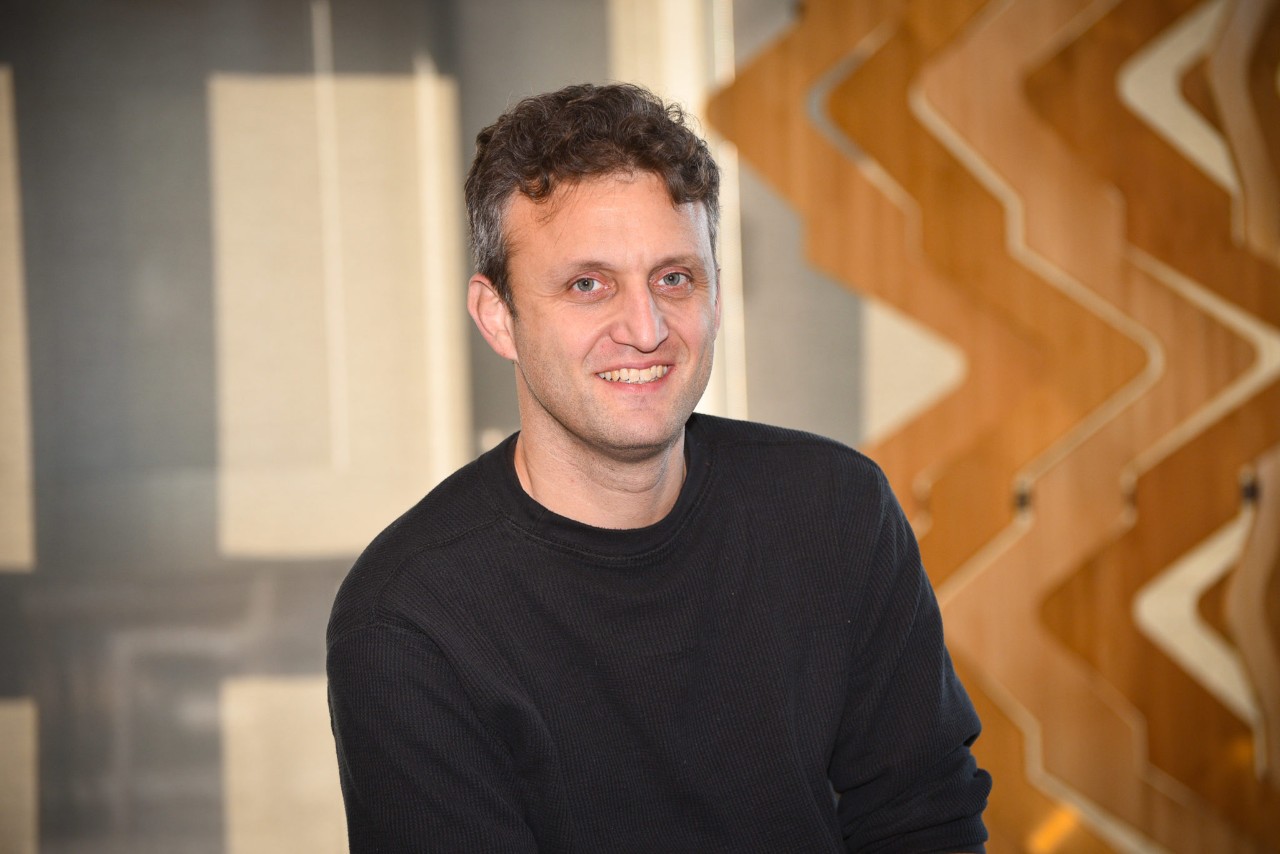 Edward Santilli, PhD, assistant professor of physics, College of Humanities & Sciences. ©Thomas Jefferson University Photography Services.
For his doctoral dissertation, Edward Santilli, PhD, assistant professor of physics, College of Humanities & Sciences, created a computational method of simulating internal waves in a realistic oceanic environment, a previously intractable task. This allows him to study the mixing and movement of nutrient-rich sediments and biological materials that keep our oceans and our atmosphere “healthy.” Read on to learn about Dr. Santilli’s research and its ecological implications.
Q: How long have you been at Jefferson? What led you here?
A: I attended graduate school at the University of North Carolina at Chapel Hill. Before that, I was a math teacher at Frankford High School here in Philadelphia. I always knew that I wanted to teach and do research. I don’t mean profess; I mean teach! I wanted to experiment in the classroom to find what makes the students learn best. I wanted to bring tech into the classroom and get the students actively talking instead of just passively listening. While searching for faculty positions, I read about the Nexus initiative and Jefferson's push for active learning. That was the moment I became excited about working at Jefferson.
I came to Jefferson in August of 2015. Since then, I’ve been encouraged to improve my courses in exciting ways. I was provided funds to better equip the physics labs. I was supported in my efforts to blend lectures and labs into a more active student experience and to use open-access tools and digitize course assignments. And at the same time, I’ve been able to continue my ocean modeling efforts, present at major conferences, and work with other researchers from around the world.
Also, I am from South Philly, so returning home was a bonus!
Q: Tell us a bit about your field or area of research. What's one question you're exploring?
A: Any time two different fluids meet, it can create disturbances in the interface that travel outwards as waves. The most obvious example of this are the ocean’s visible surface waves at the air-sea interface. But below the surface, there is a very different interface that gives rise to very different waves. The ocean is stratified, with heavy cold water below and light warm water above. This steadily changing density gives rise to not one but a multitude of interfaces that can be disturbed. The resulting waves are called internal waves and they behave quite differently than the familiar sea-surface waves.
We have observed internal waves being generated by many mechanisms, such as river plumes pushing fresh water into salty water, but most are formed by the tides sloshing water back and forth over undersea features such as ridges and canyons. Tidal forces deposit a vast amount of energy into the oceans, and internal waves can transport this energy hundreds or even thousands of kilometers before they become turbulent and dissipate. This turbulence is a mechanism that mixes the stratified ocean. It is this mixing that interests me and my collaborators.
Q: Why is this mixing important?
A: It is well known that this mixing plays a vital role in the chemistry and biology of the ocean. About two hundred feet below sea-level there is a sudden change in the water's temperature, salt content, and density. This region of sudden density change is called the pycnocline and it behaves like a brick wall to any chemicals or free-floating life forms that try to travel up from the abyss into the shallow ocean (or vice versa). Turbulent mixing at the pycnocline opens a sort of doorway, sending nutrients, plankton, and algal blooms to the shallow waters from the deep. Likewise, this mixing can also send carbon dioxide absorbed from the atmosphere into the abyss, where it can be permanently stored.
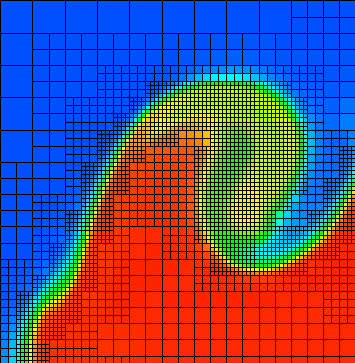 A demonstration of the adaptive grids that Dr. Santilli's model uses. As the heavy (red) fluid moves to the left and the light (blue) fluid moves to the right, the fluid in between overturns and mixes (yellows and greens).
Q: That’s fascinating! Is there a way to quantify this exchange?
A: Now here’s the problem – no one knows precisely how much mixing is taking place, how much nutrient-laden water this mixing can stir up from the deep, or how much carbon dioxide it can draw from the surface. To answer these questions, we need to observe the internal waves and the resulting turbulent patches as they evolve. But this all happens intermittently below the sea surface, making it very difficult to study in real-time. Also, the flows are too complex to properly study in the lab, so we need to rely on computer simulations. But this is also challenging because the software needs to simulate an enormous range of scales. We need to capture both the internal wave's generation and mixing sites, which we know can span several hundreds of kilometers. We also need to capture the turbulent motions, which can be as small as centimeters. No computer is powerful enough to simulate this by brute force.
This is where my computational work enters. In 2015, I wrote my doctoral dissertation titled “The Stratified Ocean Model with Adaptive Refinement (SOMAR).” SOMAR works on a simple principle -- at any given time, most of the ocean is not turbulent, so an efficient ocean model will rarely need to capture the centimeter-scale motions. SOMAR models the large-scale motions while it monitors for the onset of turbulence. When turbulence is detected, it sets off a high-resolution, small-scale model. This turbulence model calculates mixing rates and feeds that information back to the large-scale model. Once the large-scale model has properly mixed the fluid, it terminates the turbulence model and efficiently continues on its way. In short, SOMAR doesn't rely on brute force but instead focuses computational power only when and where it is needed. Hopefully, this will allow me and my collaborators to properly study the ocean's internal wave-generated mixing.
Q: What first sparked your interest in your area of research/your research question?
A: Upon entering graduate school, I had intended to create computer simulations of astrophysical phenomena such as colliding black holes, stars whizzing around galaxies, and such. I've always enjoyed computer programming, geometry, and physics, so simulating astrophysical phenomena seemed like a natural choice. The researcher I had hoped to work with created a start-up company and decided not to take on new students. This left me thinking of a new research direction. It turns out that ocean modeling is incredibly similar to astrophysical modeling. It incorporates all of the components that I enjoy. So, I met with a marine scientist who was hoping to model internal wave mixing and I got to work!
Q: What's the fire in your belly that drives your passion for your research?
A: I suppose this is the part where I speak of my research as some noble endeavor as I look off-axis "to the future." Well, I'm far less poetic than that! If I'm being honest, my work brings me the same joy that a crossword or Sudoku brings others. It is a very complex puzzle that occasionally keeps me up at night. But unlike crosswords, my work has multiple routes to success. The challenge is finding the simplest, most re-usable solution. Those are the results I can hang my hat on.
Q: What's a cool or little known or unique fact about you?
A: I was born at Jefferson!