
It has been said that building a passive house is like building a thermos – with really good ventilation. Passive building strategies use what nature provides for free to keep buildings comfortable, without the need to purchase energy. Instead, these purposefully designed, energy-efficient houses use the sun’s heat to maintain the interior climate—without the need for active heating and cooling systems.
An Aggressive Advocate for Passive Construction
How to build more efficient, passive homes – those that take advantage of natural and recycled warming and cooling through design and engineering – for the masses.
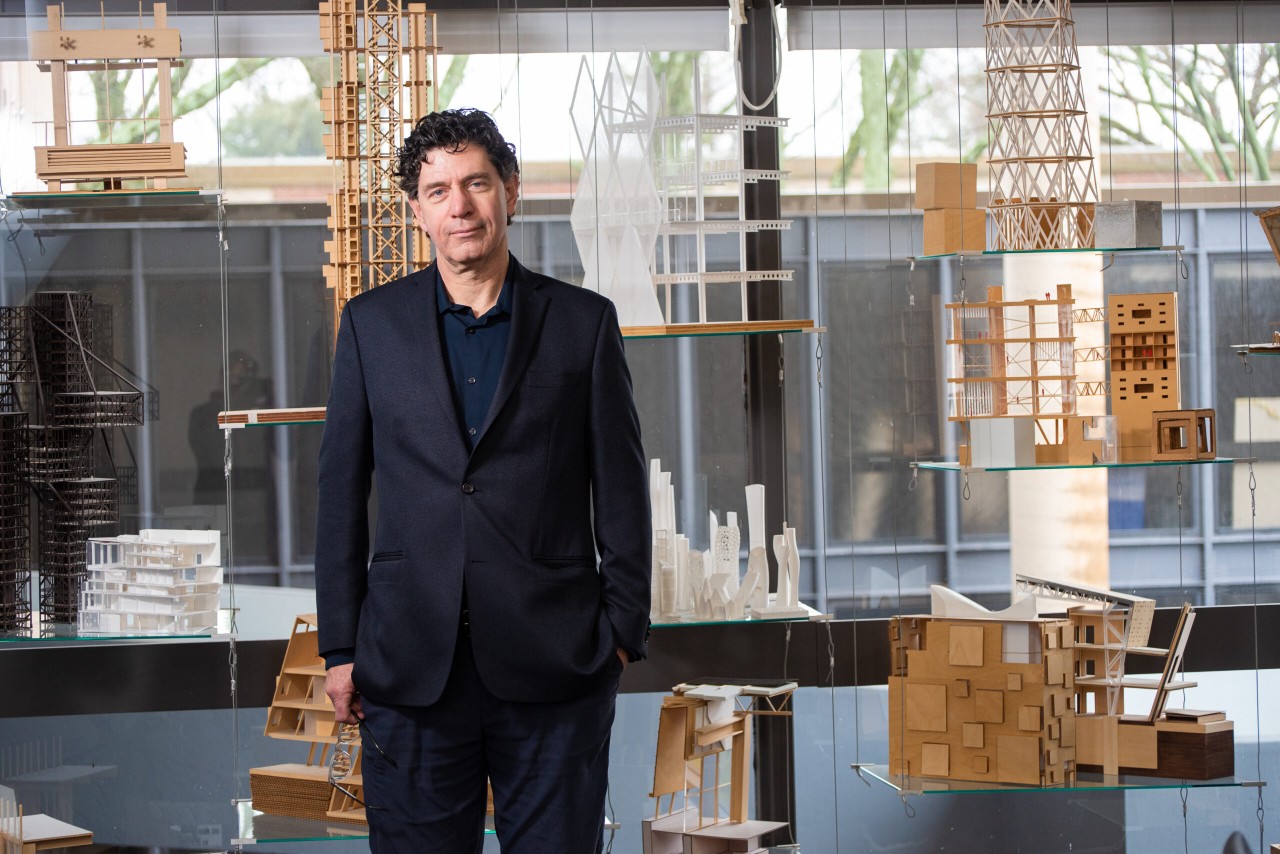 Craig Griffen, Associate Professor of Architecture in the College of Architecture and the Built Environment
“Passive house” buildings are super-insulated, virtually airtight structures that rely on solar energy and the heat generated by people and appliances to maintain climate control, especially heating in the winter. A heat exchanger called a “heat recovery ventilator” (HRV) filters outside air and transfers heat to it from indoor air being exhausted. The result: a super-efficient home with healthier air and dramatically lower heating bills. (In the summer, the HRV simply reverses the heat transfer, sending the heat outside, thus lowering cooling costs.)
The “passive house” building standard was developed in Germany and can be used to construct buildings of any type. So why are passive energy-efficient houses only a small percentage of new builds? Cost is one hurdle, but getting home owners to “buy-in” on new sustainable technology is also a factor. While there is no clear count, one database shows Germany has 15 times as many passive houses as the U.S. But in both countries, passive houses account for well under 1% of new home construction.
Craig Griffen, RA, LEED AP, associate professor of architecture in the College of Architecture and the Built Environment, focuses his research on applying passive energy strategies to the design of suburban and urban housing in ways that are more attractive and economical for today’s consumers. Find out more about Professor Griffen’s research and questions he’s trying to answer.
Q: Tell us a bit about your field or area of research.
A: My research focuses on the study of applying passive (non-mechanical) energy strategies to the design of suburban and urban housing. Even though we are in a climate crisis, most new housing does not take advantage of the sun’s capacity for passive solar heating, daylighting, and photovoltaic energy generation, so I am exploring the immense energy-saving potential of creating mass housing that is oriented toward the sun.
Q: What’s one question you’re exploring currently?
A: I’m studying a design concept for all house models that focuses on re-designing the typical backyard model to a side-yard model home. This arrangement, similar to the Charleston House typology, provides a large open space on the south side of the house with a gallery, or balcony, which runs the length of the house to provide shade. Rather than a backyard disconnected from house functions, the southern side-yard provides all occupied rooms with access to outside green space, direct sunlight and fresh air. Passive house principles are just one of five key benefits of the side-yard house, others being it is adaptable in size to a range of urban and suburban sites, utilizes prefabricated modular construction, is more resilient to power outages caused by climate change and the smaller, prefabricated homes are more affordable than developer housing.
However, because of the extra insulation, passive housing is 5-10% more expensive to build than standard construction. To keep costs down for the missing-middle housing market, (those who have a good income but cannot afford market-rate housing), I am currently studying how to build the side-yard model homes using pre-manufactured, modular construction with a relatively new technique of CLT (cross-laminated mass timber) solid wood panels.
Along with health, environmental, economic, political and social crises, we also face a grave housing crisis. Yet, housing design and construction has barely responded.
Q: How does that reduce the entry cost for a passive house?
A: Prefabricated modular construction costs 10-20% less than stick-built wood frame construction because it is more efficient in materials and time, thereby offsetting the extra costs of green materials. The open floor plan allows for the houses to be smaller in size to reduce per square foot cost without feeling cramped. Lower utility bills also save on operation costs.
Q: What first sparked your interest in your area of research/your research question?
A: Along with health, environmental, economic, political and social crises, we also face a grave housing crisis. Yet, housing design and construction has barely responded. Approximately 98% of single-family house construction is still developer driven and the vast majority are energy inefficient, unsustainable to build, and unaffordable to middle home buyers, who make a decent income but cannot afford skyrocketing real estate prices. Very little of new house construction is oriented to take advantage of the energy savings and health benefits of sunlight and fresh air. Considering the dire predictions of climate change, I was curious about the huge potential for energy that could be saved if housing produced at this large scale (averaging a million new starts in the U.S. per year) was oriented to the sun and wind.
Q: You’ve mentioned the extra costs, but what are some other barriers towards orienting new housing toward the sun? Do new private developers know of this concept/is there a lack of awareness around this?
A: Developers are looking for proven methods to make a profit and new ideas are risky. They say they will give the public what it wants but the public has to be aware of what’s available, and passive houses are still relatively new to the U.S. market.
Q: What do you enjoy most about your job?
A: Being a registered architect as well as a professor, I enjoy having the freedom of working in a design school to practice what I preach; or the opportunity to apply what I discover in my research to the actual design of buildings.
Q: What’s something you’re passionate about outside of your research?
A: I’ve played bass guitar in an alternative-blues-classic rock cover band for almost 10 years and have had students attend some of our shows in the Cheltenham Township area.
Q: Who’s a role model or someone who shaped your research journey? Is there a piece of advice that stuck with you or that you try to pass on to young researchers?
A: Quoting the Italian architect Renzo Piano, he said the role of design is to make “one move to do many things.” I teach this to my students and strive to achieve in it these housing designs.
Q: What led you to Jefferson?
A: Even though I started in 1995, the first course I taught was ironically a housing course run in conjunction with Habitat for Humanity that eventually grew into a student-designed and built house in Germantown.