
When psychiatric nurse practitioner Amy Szajna first visited India six years ago, she was confronted with a stark reality: the country has less than 1 psychiatrist for every 100,000 residents, and many fear the stigma that mental health conditions carry. She was there to help address high rates of postpartum depression (PPD), but with so many hurdles in her way, she knew she’d need to be creative.
“There’s still very much a stigma related to mental health and mental illness in India,” says Szajna. “It’s very hard to access care.”
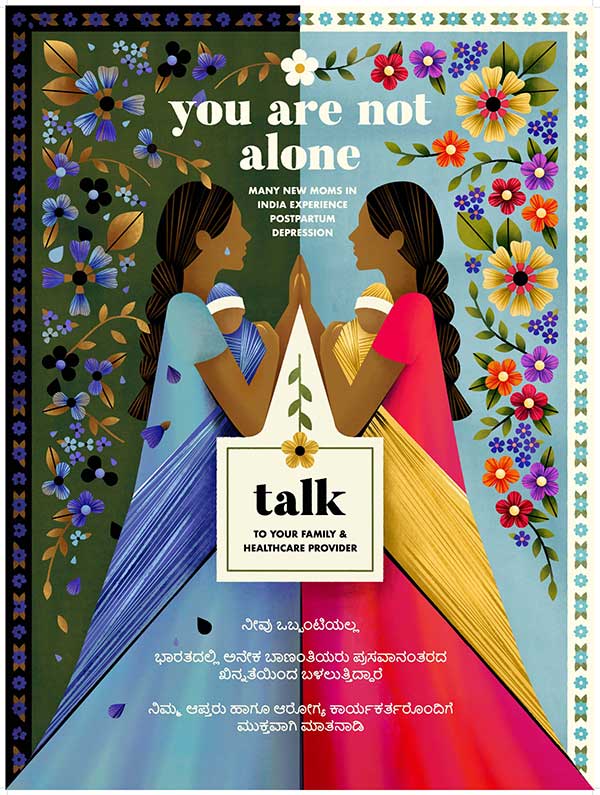
That creative problem-solving spirit took Szajna to an unexpected place: a meeting with designer and Jefferson alumna Laura Moyer. The two went back and forth, sketching ideas, referencing traditional Indian design motifs, and translating text between English, Marathi, and Kannada. The result of months of their collaboration was a brightly-hued poster, featuring two women embracing each other and their children, imprinted with a message for Indian mothers: “You are not alone.”
While roughly the one in ten new mothers in America suffer from PPD, it’s estimated to affect 1 in 5 mothers in rural areas of India. The condition can make it difficult for mothers to bond with their children, complete daily tasks, and connect with friends and family, and, if left untreated, PPD may evolve into long-term mental health issues. In some regions, it’s common for new mothers to stay with their in-laws after giving birth, and women may remain isolated at home for weeks or months postpartum.
Szajna hopes to hang and distribute these posters around the southwestern Indian city of Belgaum. To address the lack of mental healthcare in the area, she and collaborators at KLE University have been training community health workers to screen for PPD at standard pediatric vaccination appointments, and to follow up with a simple intervention for mothers with signs of PPD. The intervention uses the evidence-backed technique of behavioral activation, which encourages people to set goals and schedule tasks to break unhealthy loops of avoidance and withdrawal.
Her initial results are promising: in a pilot study of 24 mothers with signs of PPD, regular check-ins with community health workers and the behavioral activation intervention helped every woman feel better after just a few weeks.
“It was a good experience,” said one mother in the study. “It strengthened my personality and my mood.”
Szajna hopes as the program expands, she can display and distribute the poster to further raise awareness of PPD for women in the region. Moyer and Szajna say they worked to design the poster in a way that would best resonate for the local community, rather than relying on conventional notions of medical design and communication styles.
“If I designed something very minimalist,” says Moyer, “it might not resonate with that audience at all.” Szajna agrees; she explains that in a culture full of bright, colorful imagery, a black-and-white pamphlet might not engage people the way they need it to.