

Jefferson Studio Wins National Award for Housing Without Displacement Project

In neighborhoods like Hunting Park, the geography of vulnerability is visible from block to block. It can be seen in the aging housing stock, limited tree canopy and excessive impervious surfaces which intensify urban heat island effects while placing disproportionate environmental and health burdens on lower-income residents. At the same time, a powerful network of civic, cultural and faith-based organizations anchors community life.

This tension formed the foundation of Housing Without Displacement, a design studio led by John Dwyer, Architecture Department Chair and Associate Professor in the College of Architecture & the Built Environment. Dwyer’s research focuses on advancing the discipline of architecture through the lens of serving underserved communities and positioning design as a vehicle for equity, health and long-term resilience. The project has been recognized with the prestigious AIA/ACSA Housing Design Education Award, presented in partnership with the American Institute of Architects, which honors excellence in housing design education that prepares architects to lead and serve their communities.

The award recognizes the work of students Amani Harb, Akshara Manda, Naveen Vempati, Khaja Faizan Ahmed, Dania Abdul Rahim, Aubrey Saunders, Chloe Diaz, Emily Morina, Sabira Haque, RJ Anselm and Khushali Rushabah Shah, whose collective research and design proposals centered on equity, public health and climate resilience.
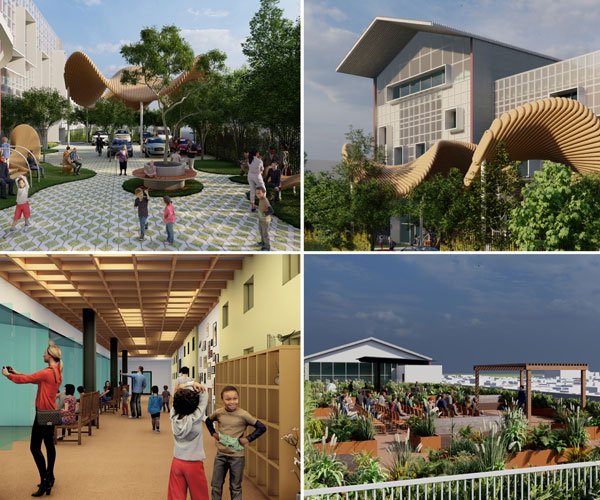
Students designed affordable housing that benefit the community.

Rather than treating sustainability as a technical checklist, the studio framed it as a form of civic care. Working directly in Hunting Park, students mapped public-health data, crime patterns, food insecurity, heat island intensity and housing instability before designing a single wall.

“Housing Without Displacement demonstrates that design education can be both rigorous and rooted, analytical and empathetic,” states Dean Barbara Klinkhammer.

Their proposal would transform an existing community center into a hub for health, learning and resilience, while modeling deeply affordable housing on vacant, city owned lots within walking distance of the Lenfest Center, a community hub located in the Hunting Park neighborhood of Philadelphia. By intentionally selecting empty parcels, the team prioritized development without displacement. In partnership with local organization N10, students amplified community voices and strengthened the Lenfest Center’s role as a social anchor.

Midway through the semester, the studio faced an unexpected change when the competition the class had originally planned to enter was cancelled. Rather than retreat, the students used the moment to expand the scope of their work. Housing quickly emerged as the studio’s unanimous focus, centering the most urgent needs of the neighborhood and broadening the project’s impact.

“Being recognized with an Architectural Education Award affirms that architecture can operate as a form of civic responsibility, not just aesthetic production,” Anselm shared. “Our studio did not work in abstraction. We worked in Hunting Park.”

Students described the project as a lesson in ethical decision making, where carbon accounting, zoning and material sourcing were positioned as measurable responsibilities. The work placed architecture at the crossroads of public health, equity and environmental impact, reinforcing that socially grounded design is essential to the profession’s future.

For Dwyer, the award reflects the character of the studio itself.

“More than anything, this award is a reminder of how extraordinary our students are,” he said. “Their fearlessness, positivity and adaptability transformed a moment of uncertainty into an opportunity to address one of the most pressing issues of our time.”

In Hunting Park, the studio reimagined sustainability not simply as performance metrics, but as a framework for dignity, health and long-term community stability.

Share This