
In this Nexus series, Get My Job, we interview alumni and faculty from one of the University’s 160-plus undergraduate and graduate professional programs. The latest installment features Capt. Michael Honsberger, who volunteered on “The Pile” after the Sept. 11 terrorist attacks, served as a combat medic in Iraq and Afghanistan, and now is helping analyze COVID-19’s impact on his community.
Get My Job: Spotlight on Disaster Medicine and Management
Alumnus Capt. Michael Honsberger volunteered at Ground Zero after Sept. 11, served as a combat medic overseas and now plays a crucial role in COVID-19 efforts.
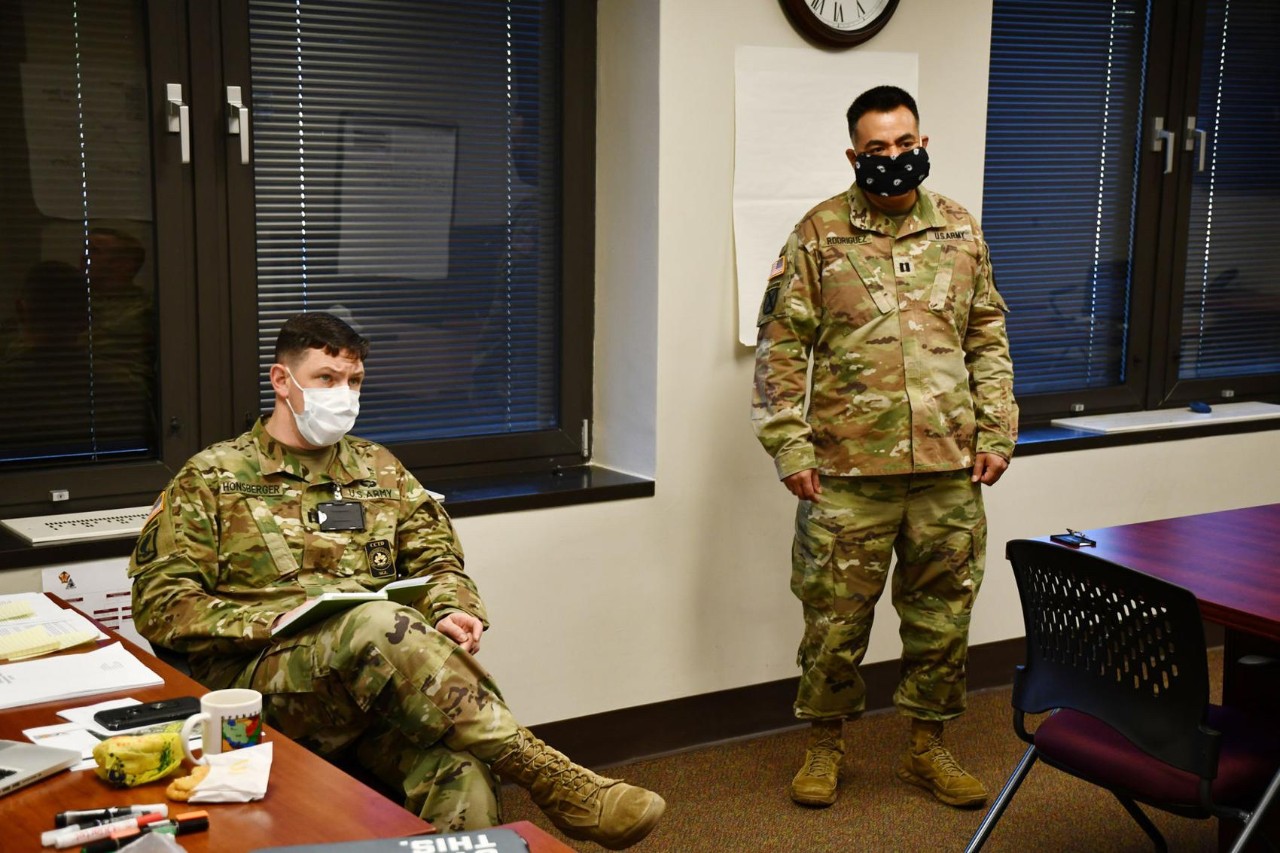 Jefferson alumnus Capt. Michael Honsberger (left) currently serves as a small group leader and instructor/writer at the Army Logistics University in Fort Lee, Va.
What did you major in at Jefferson and how did this program best prepare you to enter the field?
I completed my master’s in disaster medicine and management in 2019. The program prepared me for serving as a military liaison to civilian agencies in Defense Support of Civil Authorities. It also exposed me to the larger context of disasters and how the Military Health System is integrated and essential to a large-scale disaster response like we’re seeing during the COVID-19 pandemic.
I enjoy coaching, mentoring and teaching the younger Medical Service Corps officers who serve on my staff. COVID-19 is their 9/11.
What was your career path to land in your current position?
I earned my emergency medical technician–basic from LaGuardia Community College in New York City in 2000 and served in the New York City Emergency Medical Service (EMS) based out of New York Hospital Queens (NYHQ) from January 2001 to October 2002.
A watershed moment was volunteering at Ground Zero after the Sept. 11 terrorist attacks. The NYHQ EMS teams deployed to the Jacob Javits Convention Center then staged at Chelsea Piers to provide support. After a few hours on “The Pile,” my crew and I returned to our area of responsibility in and around Flushing. This experience led to my enlisting in the U.S. Army in October 2002, beginning my 17 years of service.
I served as a combat medic in the 173rd Parachute Infantry Regiment in Vicenza, Italy, and 82nd Airborne Division in Fort Bragg, N.C. In my eight years enlisted, I completed four combat deployments: one to northern Iraq in 2003 and three to different provinces in Afghanistan.
In 2011, I earned my commission as a Medical Service Corps officer serving as a company executive officer, general officer’s aide-de-camp, medical headquarters company commander and observer coach trainer at the Joint Readiness Training Center.
I currently serve as a small group leader and instructor/writer at the Army Logistics University in Fort Lee, Va.
 One of Capt. Honsberger's core responsibilities is to develop a medical common operating picture that shows positive COVID-19 cases per day, medical material usage and number of tests conducted.
Please describe your core job responsibilities today?
I serve as the officer in charge of an Emergency Operations Cell (EOC) tasked with conducting quantitative analysis on COVID-19 in the nine health districts surrounding Fort Lee, Va. Our analysis assists the Combined Arms Sustainment Command Commanding General to make informed decisions regarding COVID-19 and on the health and safety of the Soldiers, Sailors, Marines, Airmen, Department of the Army Civilians and family members.
One of our core responsibilities is to develop a medical common operating picture (MEDCOP) that shows positive cases per day, medical material usage (e.g., ventilators) and number of tests conducted. The MEDCOP assists the Kenner Army Health Clinic Commander understand how COVID-19 is impacting communities within a 100-mile radius.
I have to make recommendations to senior leaders that may have a direct impact on whether we begin to relax social distancing precautions and begin the slow return to a new normal.
What are the favorite parts of your job?
Discussing COVID-19’s impact to the Fort Lee garrison and how we’re mitigating its effect at the tactical, operational and strategic levels.
I also enjoy coaching, mentoring and teaching the younger Medical Service Corps officers who serve on my staff. COVID-19 is their 9/11. I can provide firsthand knowledge of what it’s like to have served through a large-scale disaster and help them process what they’re seeing, doing and feeling. I’m hoping our shared experience in the EOC will lead some to follow the path I started walking 20 years ago.
Disasters are becoming more commonplace and destructive. We need as many trained professionals in the field providing disaster medicine and management for when, not if, the next disaster strikes.
What’s the most challenging aspect of your job?
To make unpopular recommendations based on the quantitative data collected. I’m still seeing an increase in positive COVID-19 cases now that testing has become more commonplace, and I have to make recommendations to senior leaders that may have a direct impact on whether we begin to relax social distancing precautions and begin the slow return to a new normal.
What’s your one piece of advice for students considering entering this major or profession?
I highly recommend they volunteer at their local fire or emergency medical station or a community emergency response team. Even during a pandemic, these organizations are filled with passionate, dedicated people who rise to every challenge.
This is what it means to be in the emergency medical field; disasters are becoming more commonplace and destructive. We need as many trained professionals in the field providing disaster medicine and management for when, not if, the next disaster strikes.
***