
There are numerous design elements in a building – one of the most visible and increasingly complex is the building envelope. Similar to the human skin, the building envelope is the boundary between the interior and exterior of a building. Besides protecting the indoor environment, a good envelope facilitates climate control and reduces the energy consumed by a building. Researchers like Kihong Ku, DDES, Associate Professor of Architecture in the College of Architecture and the Built Environment, are looking for innovative ways to improve building envelopes, using advancements in computational design and fabrication technology. Here we talk to Professor Ku about his interdisciplinary research, read on to learn more.
How Can Textiles Be Applied to Develop Novel Building Envelopes?
Bridging technology, textile design and architecture.
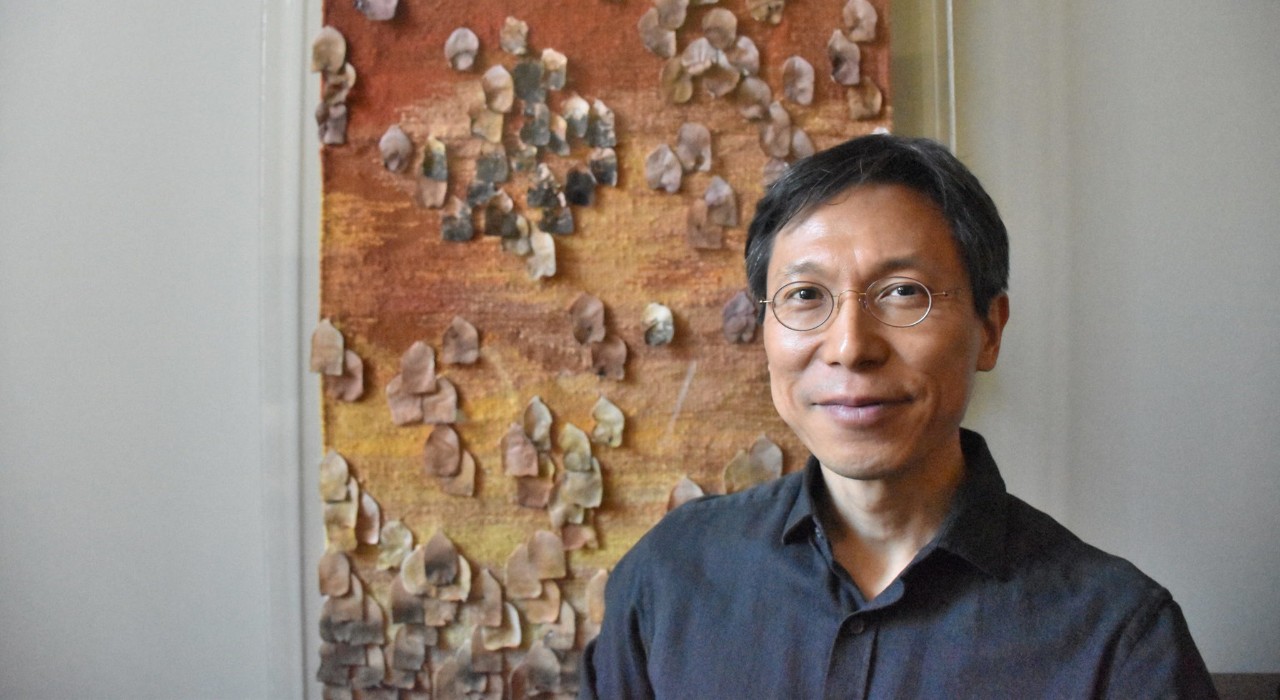 Kihong Ku, Associate Professor of Architecture in the College of Architecture and the Built Environment.
Q: What is your research focus?
A: My broad focus is on technology in architecture, particularly how technology empowers designers to enhance design capabilities. Buildings today are quite complex, requiring highly sophisticated design and engineering to meet the ever-increasing expectations for higher performance, that is, energy-efficient, better indoor environmental quality, safer and efficient structure, while offering unique spatial experiences. Designers use computers to generate multiple alternatives and represent novel forms that satisfy complex functional, societal and cultural demands. As a result, we can improve the complex tasks of integrating architectural, structural, constructional, and environmental systems into buildings, and develop built environments that more effectively respond to changing user needs.
Q: What’s one question you’re investigating?
A: Within in my broader interest of technology, currently I am looking into how textile materials can improve building envelopes.
The building envelope is a critical element in achieving energy efficiency and human comfort because it facilitates light and heat transmission and natural airflow while providing a protective layer from the elements. Building envelopes have come a long way from the early periods when building materials of stone and brick were adopted into heavy load bearing walls, columns and arches as that function as both structure and building skin. With the industrial development of reinforced concrete, steel and glass, the modern curtain wall system emerged separating the building skin from the load bearing structure. This liberated the building envelope to become a light skin layer that functions primarily as weather protection and climate control layer. Textile materials, whether it is fiber-reinforced composites or fabric- or foil-membrane materials are the next frontier of building envelope materials that offer opportunities for the expression of lightness and controlled transparency and meet contemporary aesthetics of intelligence, sustainability, and complexity.
I am investigating how we can take advantage of emerging material innovations in textiles and fibers. For example, reconfigurable mold systems that enable cost effective production of complex-shaped fiber-reinforced composite panels for building envelope applications. Another area I’m interested in is adaptive building envelope systems that intelligently respond to changing seasonal and weather conditions by integrating adjustable shading systems, and ventilation mechanisms that have embedded sensors and actuators. These types of projects take advantage of computational design and fabrication technologies, with the underlying goal to develop high-performance building envelopes.
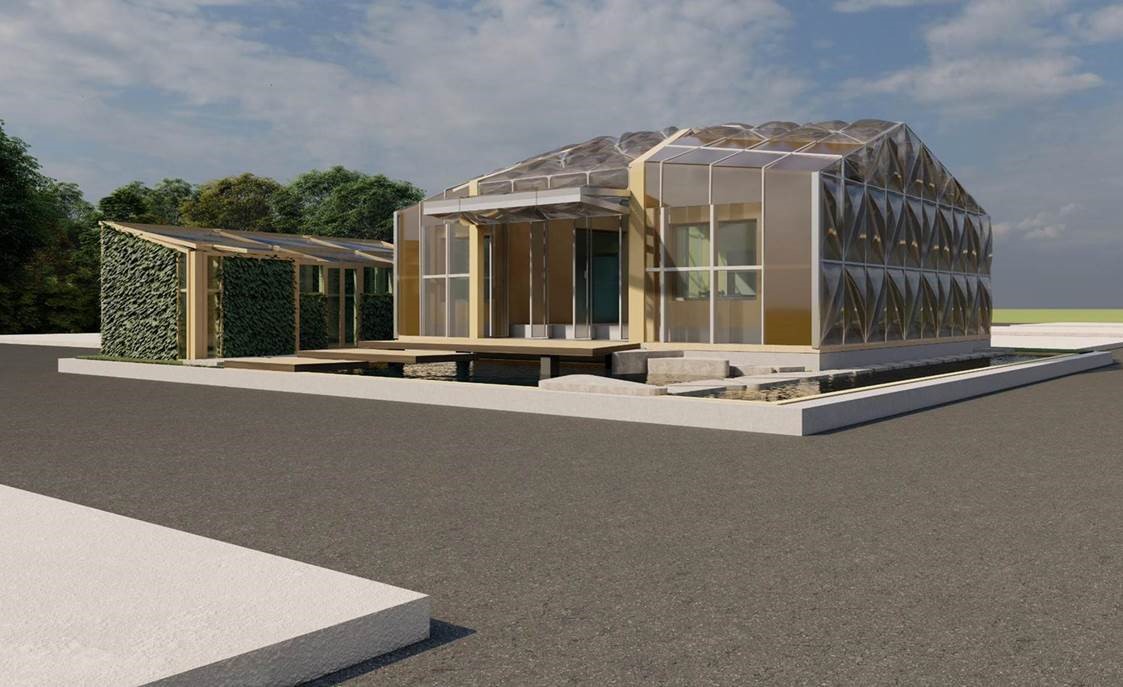 A building envelope designed by eleven Jefferson students in Professor Ku’s ARCH507 Design 9 and ARCH508 Design 10 studios, in collaboration with faculty and students at Xi’an Jiaotong-Liverpool University (XJTLU) and Zhejiang University-UIUC Institute for the Project for Solar Decathlon China 2021 competition.
Q: What first sparked your interest in your area of research?
A: My broad interest in design technology started as a college student in architecture. At the time, I became aware of CAD (computer aided design) which provided alternative means to manual drawing and drafting. This early interest in CAD evolved gradually into a more specific research inquiry that led me to pursue doctoral studies to investigate the impact of emerging technology on design. Joining Philadelphia University was another factor that led to my current inquiries in textile material strategies. Interacting with colleagues and students in textile design and textile engineering has been exciting since we all have an interest in design and materials.
Q: What’s a cool fact about your study subject?
A: Through my interdisciplinary collaborations between architecture, textile design, and engineering, I have been able to broaden my understanding of the similarities and differences between the disciplines. The collaborative investigations with textile colleagues have been very fruitful not only because we have come up with new forms or techniques for making things but also because we have learned about the different thought processes and ways to bridge them. For example, textile design approaches are often what I think of as tactile bottom-up approaches where the investigation starts at the level of the yarn that subsequently becomes a fabric. Architecture on the other hand, can often be a top-down approach starting from an overall concept or form that materializes afterwards. Bridging those two approaches has helped to come up with new approaches for both disciplines.
Q: Many researchers have superstitions. Things they’ve done to cosmically help their experiments succeed. What are yours?
A: I don’t have any particular superstitions, but I generally feel like things are going to be successful when I am able to complete the required steps of a project on time.
Q: What’s the best part of your job?
A: Lifelong learning through research and teaching, and working with engaged students who are passionate about learning together.
Q: What’s something people would be surprised to find out about you?
A: I have lived in a few countries, including Germany, South Korea, US, and China. I feel fortunate that I had the opportunity to be immersed in different western and eastern cultures and diverse cultures, and I particularly enjoy living in larger cities. Philadelphia is particularly attractive to me because it’s a highly walkable city.