
In 2016, millions of financial documents and legal records were leaked from the Panamanian law firm Mossack Fonseca. The confidential documents that came to be known as the Panama Papers exposed how some of the world’s most powerful people have utilized offshore bank accounts to conceal their wealth and avoid taxes. Just last fall, an even bigger leak called the Pandora Papers brought further scrutiny to these questionable, and in many cases illegal, practices. There has also been greater interest in understanding “tax havens” – countries with artificially low taxation rates and laws that make it easy for someone to create a secret or shell company to hide assets. For instance, as part of the response to Russia’s invasion of Ukraine, the United States is sanctioning the wealth of a number of Russian oligarchs, which is often hidden in various tax havens all over the world.
How Does Tax Evasion Impact Economic Inequality?
Understanding how some of the world’s richest people hide their wealth in order to avoid taxation and accountability.
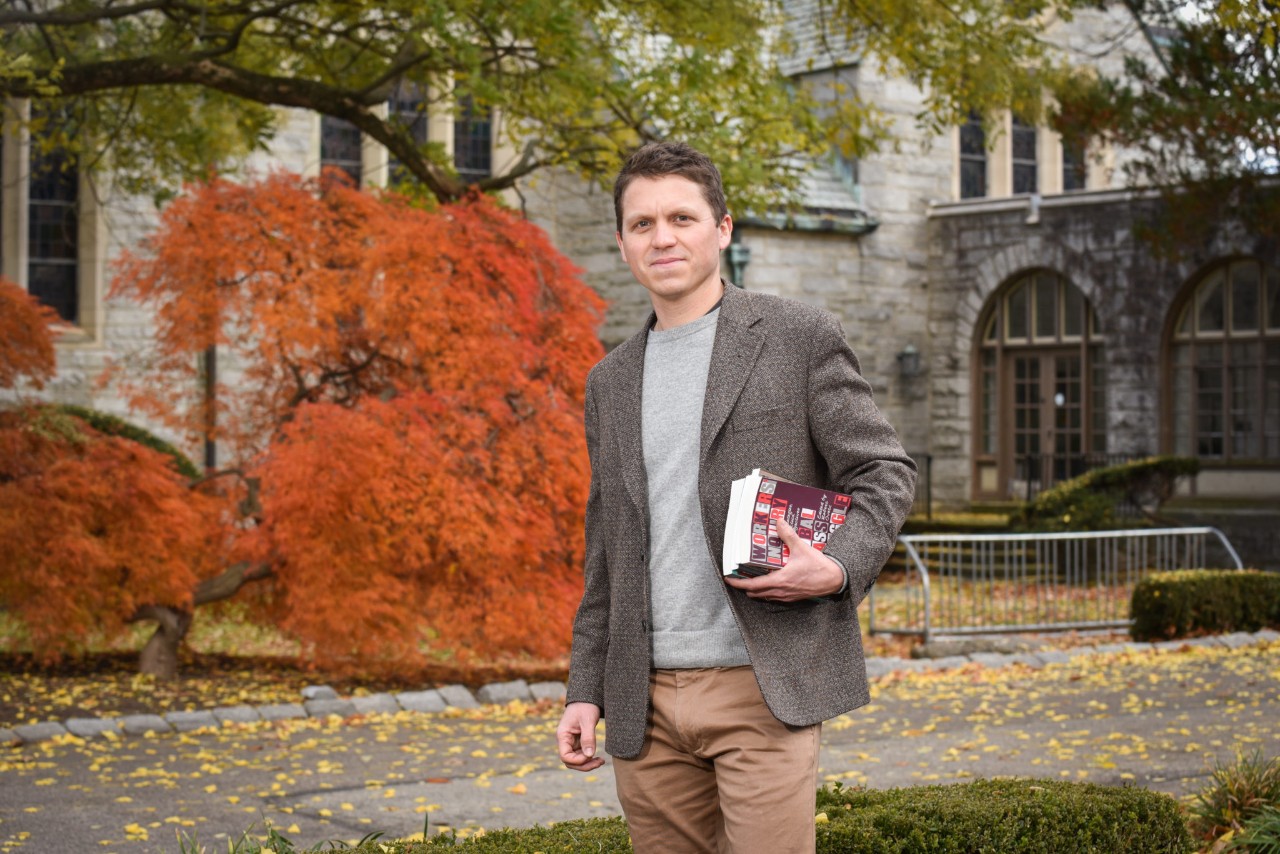 Samuel Weeks, PhD, of Jefferson’s College of Humanities and Sciences. ©Thomas Jefferson University Photography Services.
While there are legitimate reasons to create and use offshore accounts, it is clear that the lack of accountability exacerbates socio-economic inequality and enables the reins of power to be held by a small few. Samuel Weeks, PhD, assistant professor of anthropology and Interim Program Director of Interdisciplinary Studies in Jefferson’s College of Humanities and Sciences, studies tax evasion and its impact on global inequality. Read more about Dr. Weeks’ research below.
Q: How long have you been at Jefferson? What led you here?
I’ve been at Jefferson since the fall of 2018. I moved to Philadelphia from Los Angeles after completing my PhD at UCLA.
Q: Tell us a bit about your field or area of research. What’s one question you’re exploring?
In my research, I examine banking secrecy and tax havens – particularly the European country of Luxembourg. During the last five years or so, I’ve been studying how this tiny country uses secrecy and artificially low tax rates as a way of attracting the money of wealthy individuals and corporations from around the world. As I ask, in an era of increasing inequality – to say nothing of the twin challenges of COVID-19 and climate change – why is it that a rich few are able to forgo their societal obligations by avoiding their fair share of tax?
As I’ve found in my research, the development of offshore finance in Luxembourg was not due to globalization or entrepreneurialism, but was rather a state-guided process to create a workforce whose income taxes could fund what is now the country’s generous welfare state. Thus, paradoxically, it is tax flight from, say, the United States or France – which leads to a decline in the quality of public services in these countries – that subsidizes the current high standard of living in Luxembourg.
As I ask, in an era of increasing inequality
Q: What first sparked your interest in your research question?
November 2014, a few months after my first trip to Luxembourg, was the beginning of the “LuxLeaks” scandal – which was a bit like the Panama Papers and the Pandora Papers in that it exposed widespread tax avoidance by wealthy multinationals. The “LuxLeaks” showed how a single official from the Luxembourg tax authority signed off on deals allowing some of the world’s richest corporations – including Apple, Amazon, Fiat, Pepsi, Ikea and Koch Industries – to essentially pay no tax. When these companies don’t contribute their fair share to essential public resources, it means that others have to make up the difference, such as from the income taxes of middle- and working-class earners in the United States and elsewhere. Needless to say, it was in the fallout of the “LuxLeaks” that I established the basis for my current research project.
Q: What drives your passion to do this research?
As is detailed in the “LuxLeaks” and Panama Papers, the amount of tax that these wealthy companies and individuals avoid by routing money through Luxembourg is simply staggering, in the tens of billions of dollars – money that could instead be used to improve infrastructure, education and health care in the United States and other countries. It is the injustice of such arrangements that drives my passion for this research!
Q: What’s a little-known fact about your work?
We tend to think of the “offshore finance” that takes place in tax havens as something that only affects far off tropical islands, but that’s absolutely not the case! The money that, say, the City of Philadelphia lacks for improvements in infrastructure, education and health care very much exists – but, too frequently, it remains hidden in the ledger of a company with operations in Luxembourg or in one of the world’s many other tax havens.
Q: If you had any words of advice for an aspiring researcher in this field, what would they be?
Make sure that you digitize your field notes! Had I not done this, the months of painstaking research that I had conducted until then would have amounted to nothing when I unfortunately lost one of my field notebooks. It is fieldwork crises like this one that aspiring researchers should try to avoid at all costs.