
It’s a windy day at Caracasbaai, a pebbly beach with cerulean waters along the southern coast of Curaçao. Far from shore, biology professor Manuela Tripepi, PhD, is trying to paddle her kayak back to the beach as the wind thrusts her out to sea — but the angry, two foot-long sea turtle in her lap isn’t making it easy.
Saving Sea Turtles, One Paddle at a Time
This summer, Dr. Manuela Tripepi traveled to Curaçao to research the disease ravaging sea turtles across the Caribbean.
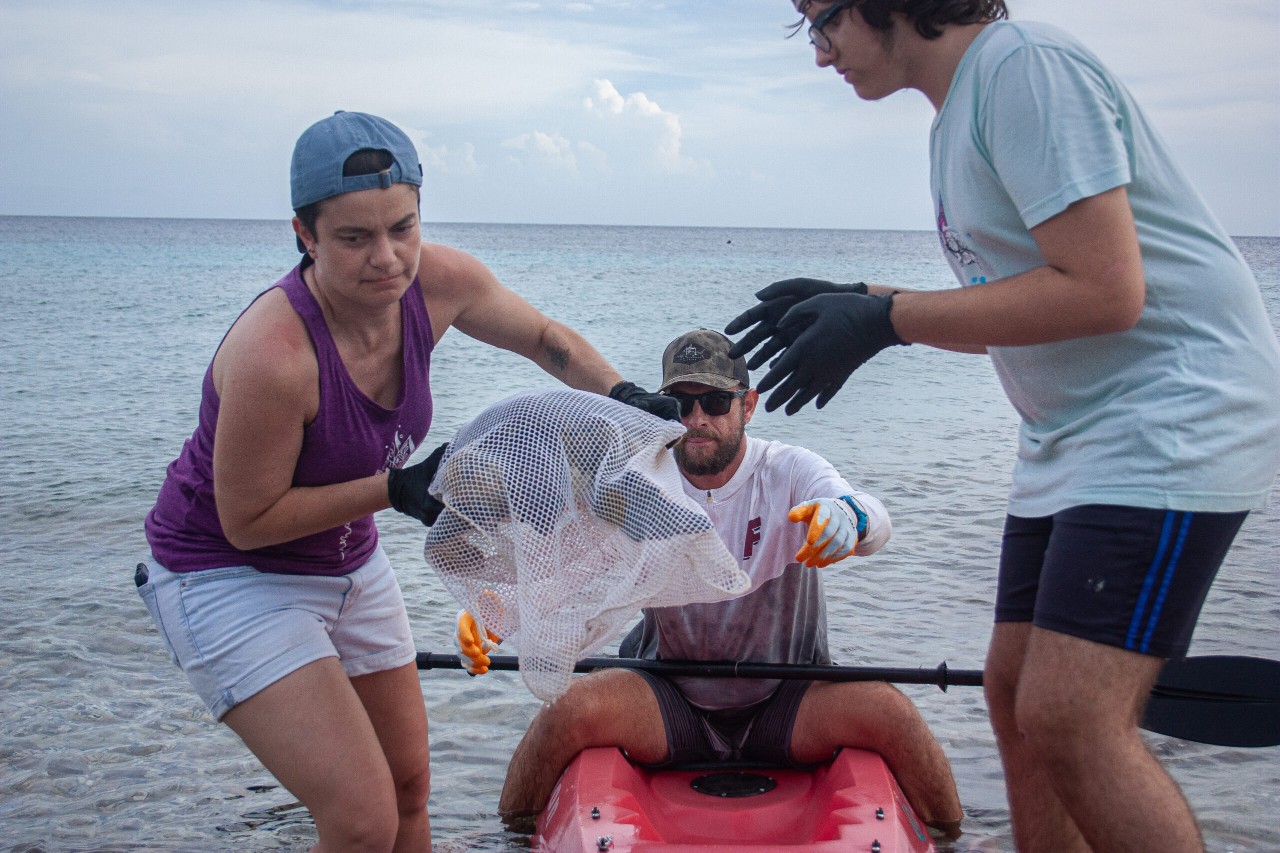 Dr. Tripepi lifts a sea turtle from a kayak with the help of fellow volunteers. (From left to right: Dr. Manuela Tripepi, Alexander Neels, Ali Ajubi)
“I never realized how strong sea turtle flippers are until one slapped me,” Dr. Tripepi laughs.
Dr. Tripepi needs to get the sea turtle back to shore so she and other volunteers can affix a small radio transmitter to its shell. This turtle is part of a population where almost 3 out of 4 are afflicted by fibropapillomatosis, a tumor-causing disease associated with the herpes virus. The condition causes tumors to bloom over the turtles’ shell, face, and flippers. While these tumors are benign, they can grow so large that turtles become unable to see, swim, or eat, ultimately resulting in death.
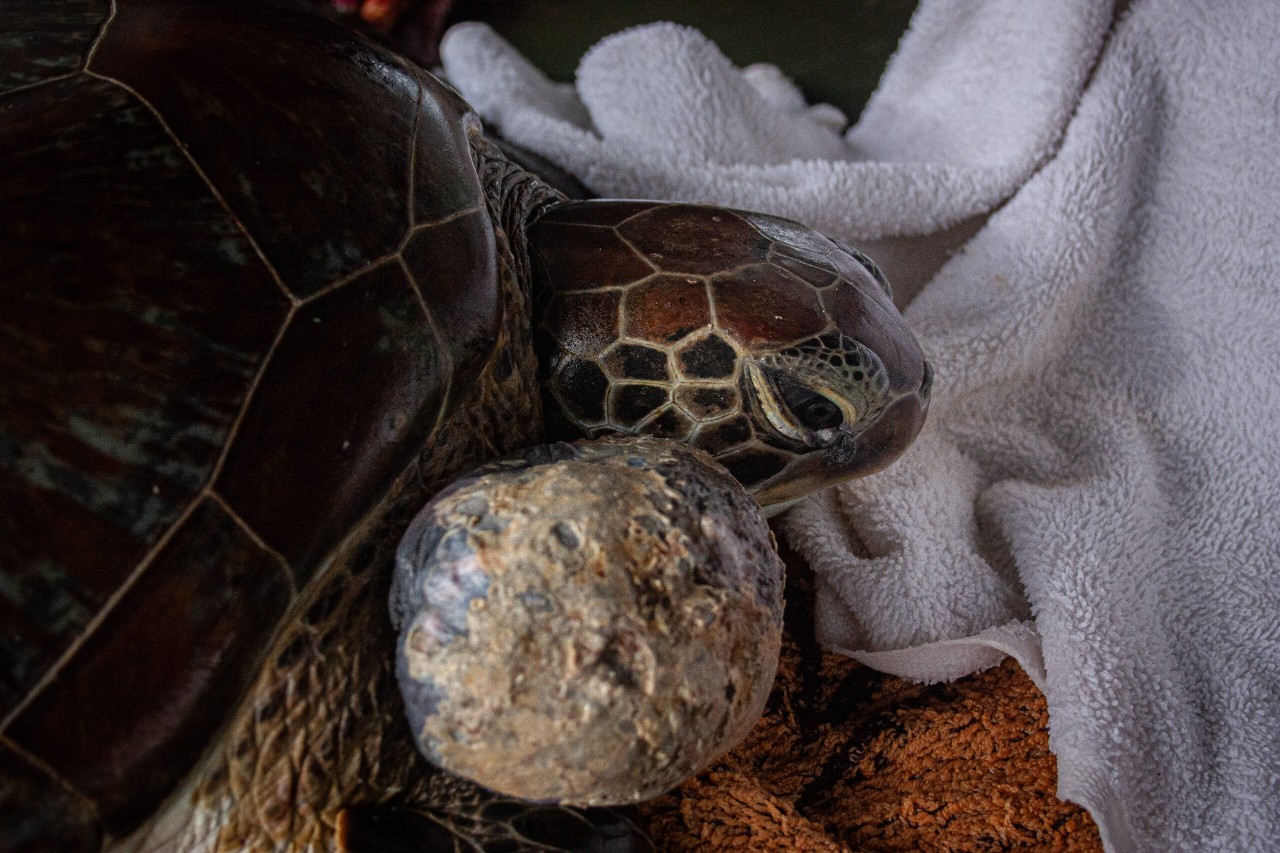 Fibropapillomatosis tumors can grow so large that they prevent turtles from swimming, seeing, or eating.
It’s clear that fibropapillomatosis is a significant threat to Caribbean green sea turtles, who are already endangered. What’s less clear is exactly what causes the virus to activate in some groups of turtles and not others.
The prevailing theory is that fibropapillomatosis is activated by stress. As an expert in how stress affects different organisms, Dr. Tripepi wants to see if something about the sea turtles’ feeding ground — such as pollution or a change from their natural diet of seagrass — is making the turtles more susceptible to the disease. But first, she had to find where they were.
The Sea Turtle Conservation Curaçao volunteer divers had seen sea turtles frequent the waters around Caracasbaai, but they were unsure where those turtles went to eat. To locate their feeding grounds, Dr. Tripepi brought radio transmitters all the way from Philadelphia to track the turtles. In order to secure those tracking devices, divers needed to scoop up the turtles, deliver them to a kayaker (in this case, Dr. Tripepi), and then shuttle them back to shore.
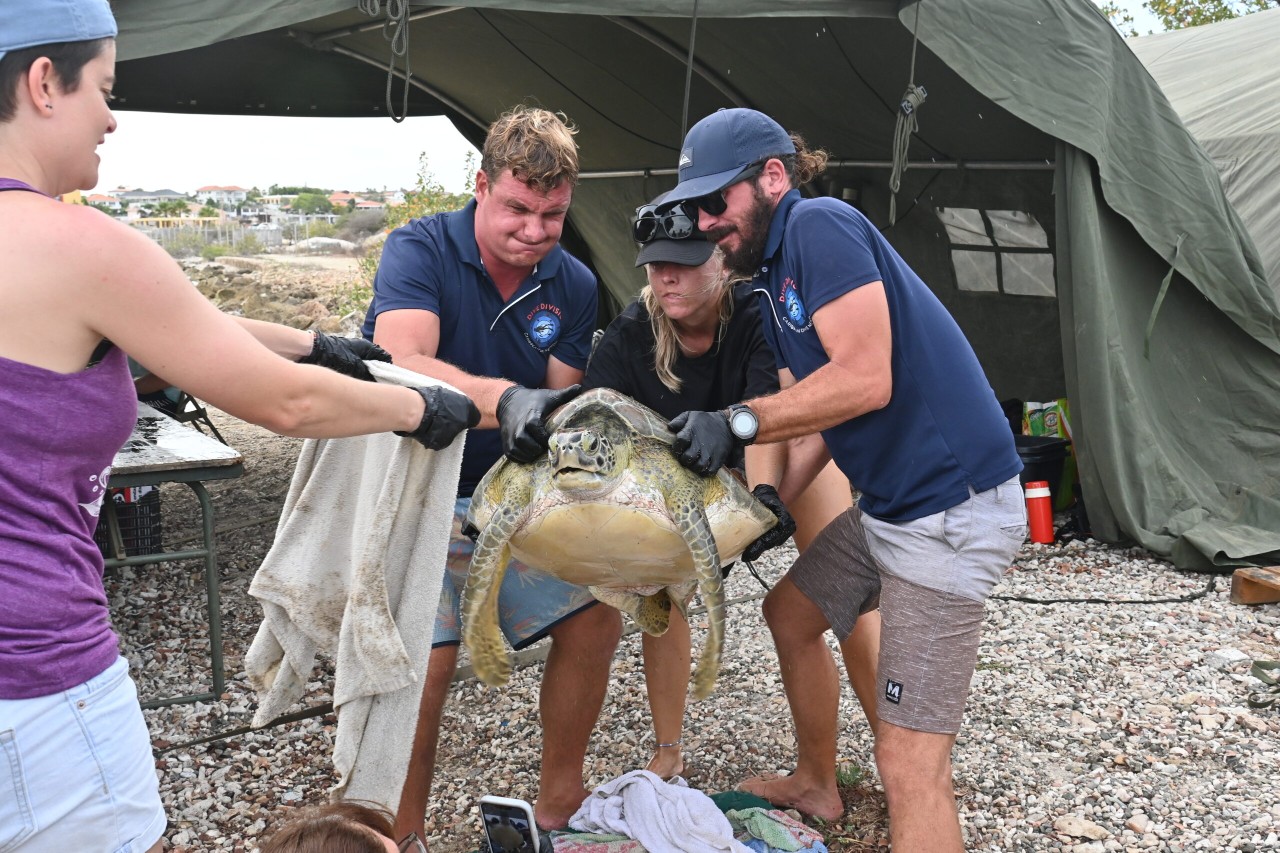 The sea turtles are often so heavy that it takes three volunteers to lift them. (From left to right: Dr. Manuela Tripepi, Cas Ortmans, Demi Deumers, and Dennis Van Roosmalen)
“I felt like kayaking back to shore would never end,” she says. Motorized boats weren’t available to the volunteer team, and while Dr. Tripepi is in good shape, even an Olympic athlete would struggle to pacify an angry sea turtle in the middle of their workout. Every few moments, she switches between paddling against the gusting wind and massaging the back of the turtle’s neck, a trick to calm them down.
When she finally makes it back to the rocky beach, Sea Turtle Conservation Curaçao volunteers are waiting with gloved hands to grab and tag the turtle, being careful to separate the diseased animals from the healthy ones — humans can’t catch fibropapillomatosis, but they could spread it to other turtles, one of many reasons to never touch a wild sea turtle.
Every few moments, she switches between paddling against the gusting wind and massaging the back of the turtle’s neck, a trick to calm them down.
Once the turtle is tagged, they release it back into the water, where it rejoins its group and hopefully points the researchers in the direction of their feeding grounds. Dr. Tripepi and the volunteers for Sea Turtle Conservation Curaçao managed to tag eight turtles in total.
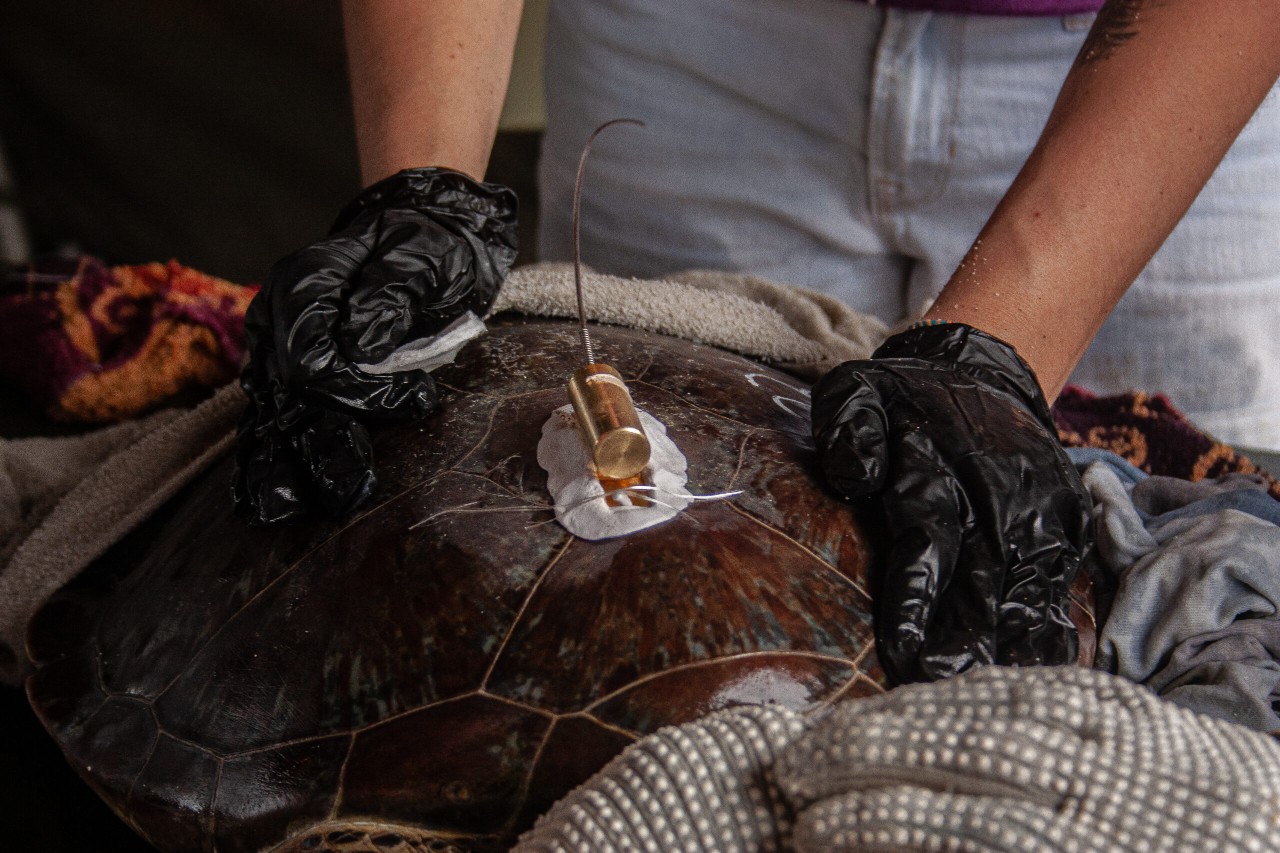 This radio transmitter affixed to a turtles' shell will help Dr. Tripepi determine its feeding ground.
For the next two weeks, Dr. Tripepi would walk to the end of a dock to listen for the turtles. Pulling out an antenna and pointing it in an arcing path across the water, she would wait for the telltale beep of a tagged turtle. With enough pings, the team will locate the turtles’ feeding ground, a small inlet away from the main beach.
While the first phase of the project is complete, Dr. Tripepi still needs to analyze the water and seagrass from the inlet to look for stress-inducing changes that could have triggered the fibropapillomatosis outbreak. But for now, she’s still riding the high of being part of the major volunteer effort Curaçao is undertaking to save their turtles.
“This research has such a significant impact,” says Dr. Tripepi. “We only have one planet, and we need to find out what is making our ecosystems sick.”