
Regulating the Nervous System Through Art

Lyn Godley reflects on founding the Jefferson Center of Immersive Arts for Health and building a body of research that reimagined art as a therapeutic tool.

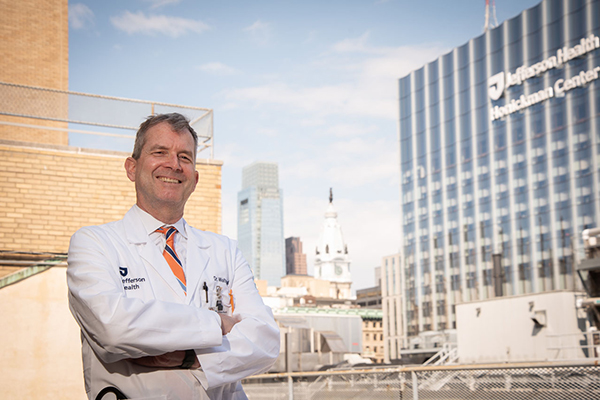
Lyn Godley, MFA, professor of industrial design and director of Jefferson Center of Immersive Arts for Health. Photo Credit: ©Thomas Jefferson University Photography Services

What if the waiting room, the exam hall or the hospital corridor could help you feel better before you ever saw a doctor? Lyn Godley, MFA, professor of industrial design and director of the Jefferson Center of Immersive Arts for Health (JCIAH), wants to answer exactly that question in her research. Drawing from her background in fine art, she’s spent her career studying how immersive, light-based installations affect the nervous system, and whether carefully designed sensory environments can serve as a reliable tool for stress relief and emotional regulation.

The work has taken her on a journey from art galleries in Europe to Jefferson’s own medical centers. As she prepares to retire in August, Godley reflects on how her career has bridged fine-art practice, neuroscience and evidence-based design and challenged the assumption that art in public spaces is merely decorative.

How would you describe your research to the person riding the elevator with you?

I study what happens when immersive, light-based art is placed where people are stressed and “stuck,” like in waiting rooms, clinics or campus spaces, and measure whether the experience reliably reduces stress and lifts mood. Ultimately, I want to see if carefully designed, slow, rhythmic light and imagery can act like a gentle, non-pharmaceutical intervention that helps people feel calmer, more connected and more capable of coping.

Why is it important to understand how environmental design affects people?

The field of environmental design, particularly evidence-based design in healthcare, has demonstrated that built environments measurably influence human physiology and emotional state. Foundational studies by researchers such as Roger Ulrich showed that access to natural views can reduce stress, pain medication use and recovery time, establishing a link between visual environment and autonomic regulation.

My work addresses the emotional strain built into healthcare and high-stress environments: People arrive anxious, overstimulated, uncertain and often alone. My research asks how we can design the environment itself, using art and light, so it supports regulation, relief and a sense of being held, rather than adding to stress.

Do we know the science behind why environmental features have the effects they do?

Emerging research suggests that many of the features of immersive environments can act through biological mechanisms in our bodies. For example, slow, steady rhythms calm the nervous system, and color and light wavelength affect our internal clocks and hormonal responses. Wide-field immersive environments can engage peripheral vision, which the brain associates with safety, and the sustained exposure allows the body's stress response to measurably settle. No single, unified theory explains all of this yet, but the evidence suggests that thoughtfully designed sensory environments can reliably help shift people out of a state of heightened stress.

What was the inspiration behind founding the JCIAH?

It began with an exhibition I had in Cologne, Germany, in 2011, where I embedded fiber-optics into a series of charcoal drawings of birds in flight.

As I watched viewers engage with the installation, I noticed that people weren’t just engaging visually with the work — their bodies were changing. Visitors lingered, relaxed and often shared unexpected emotional responses. Seeing the same reactions across cultures made me realize the work was affecting the nervous system, not just perception. JCIAH grew out of that question: If this kind of response can happen in a gallery, what might happen in places where people are stressed, vulnerable or in need of support?

What was the process of creating JCIAH like?

The idea really took shape during COVID, when the President of Jefferson Health at the time visited my studio to talk about commissioning work for the new Honickman Center. I first wanted to understand what kind of art is impactful in a healthcare environment, and then design from that knowledge. The leadership was very supportive of that shift, and that conversation became the catalyst for the development of JCIAH.

From there, the process was slow and collaborative. I spent a long time reaching across Jefferson Health and Thomas Jefferson University, building relationships and finding people willing to explore this intersection of art, science and healthcare. Over time, that grew into a multidisciplinary team working together on research, teaching and creating immersive work.

Photo Credit: Lyn Godley

How do you think your background in fine arts influences the way you think about the built environment?

My background in fine arts gives me a more open way of thinking. Fine art isn’t constrained by a specific problem to solve, whereas design often is. Because of that, I approach spaces less as problems to fix and more as experiences to shape. Fine-art training also gave me a broad creative toolkit, so I can use subtle shifts in color, light, rhythm and material to change perception.

What’s something you’re passionate about outside of your research?

My physical studio practice, which integrates traditional and technological media. I begin with hand-driven processes — oil painting, watercolor, charcoal and layered mark-making — grounded in the physicality of surface and gesture. These works are then expanded through projected video, dynamic light and subtle digital layering, allowing the static image to breathe and shift over time. By combining tactile materials with evolving light-based media, I create immersive environments that bridge the tangible and the ephemeral.

What has teaching meant to you throughout your career?

Teaching has been one of the greatest privileges of my life. I’ve loved being able to work with students as they define their own paths, to guide and mentor them, and to witness those moments when something shifts and a new way of seeing opens up. I hope my students carry with them the awareness of how many possibilities are available to them, and the importance of staying reflective about what truly sustains and inspires them, so they can continue on a path that feels meaningful and fully their own.

What does the future hold for JCIAH?

As I step down from my academic role in August 2026, the directorship of JCIAH will pass to two colleagues, Renée Walker and Loukia Tsafoulia, who come from different programs within the newly established College of Architecture, Design and Engineering, and share a strong focus on immersive experience and the environments we create. Their leadership expands the scope of the center in exciting ways, opening up new applications for immersive environments across disciplines. I will remain involved as a fellow, continuing to support the center’s work as it evolves.

What's next for you after retirement?

I’m very excited about this next stage. It gives me the time to return more fully to the studio, both to create the work and to write about the intersection of art, science and its potential impact.

I plan to stay involved in research, but not as the lead investigator. That shift allows me to collaborate more broadly with other institutions while staying focused on the creative work itself.

The further I go, the more possibilities open up for how art can support the body’s ability to regulate and settle. 

Share This