
Jefferson Investigates: Dyes From Invasive Plants, COVID-19 Policies That Worked and Patient-Centered Design
The latest on sustainability in fashion, studying what curbed the spread of COVID-19 best, and working with patients toward better assistive devices.
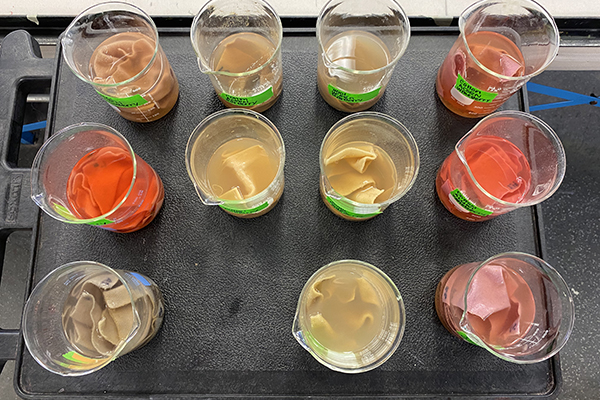 Image Credit: Becky Flax, Thomas Jefferson University
The push for sustainability in the textile industry is gaining more momentum than ever, but what will that shift actually entail? “Sustainability is such a multifaceted question,” says textile design professor Becky Flax. Everything from the fiber a textile is made from to the chemicals used in dyeing and processing can impact the environment.
One way that Flax promotes sustainability is by repurposing Pennsylvania’s invasive plant species into natural dyes. Together with biology professor Anne Bower, PhD, Flax recently tested if the roots of Japanese barberry, wineberry and oriental bittersweet could be used to dye organic cotton and wool. Flax and Dr. Bower also investigated if using the invasive red oak acorn as a mordant—a substance that prevents the dye from running—intensified the root-based dyes. Their results, published in the Journal of Natural Fibers, showed that the three invasive plants and red oak acorn mordant all had potential applications as commercial natural dyes.
The roots along with the mordant yielded dyes tinted bright citron green, dusty rose and chocolate brown. To assess the longevity of the dyes, Flax and Dr. Bower conducted tests to mimic laundering, perspiration, and rubbing up against other fabrics. Though the tests did lead to some fading, Flax says that doesn’t mean the dyes didn’t work; they just need to be used in the right circumstances. “I wouldn't recommend this being used on children's clothing, because kids tend to stress and strain their fabrics a lot,” explains Flax. But, she says, the dyes could work well for a formal garment or winter apparel.
Flax hopes to develop more techniques to improve the dyes’ colorfastness, and to determine if other parts of the plants, such as the stems or berries, can be used for dyes. She says that using local, readily available plants like these invasive species is a great way to reduce the environmental impact of the textile industry. “We're coming up with a way to use these materials,” says Flax, “and not just sending them to waste or burning them.”
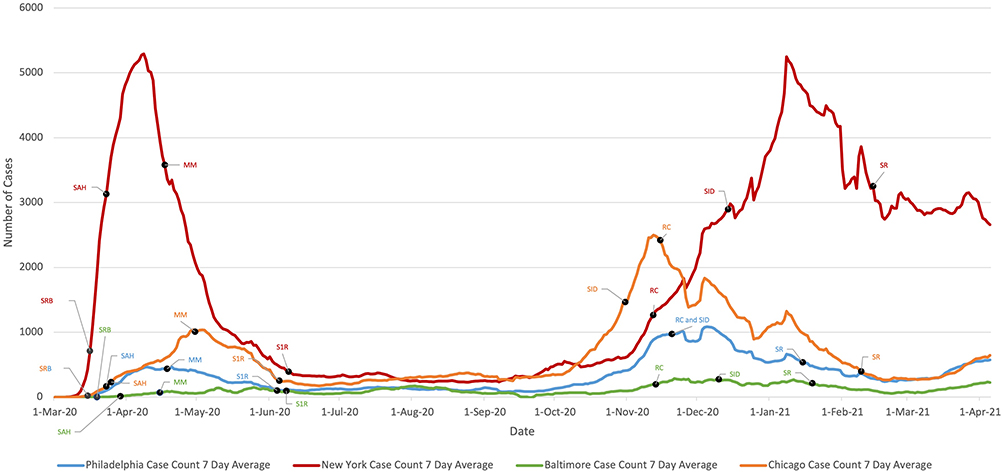 Image Credit: Goldstein and Ogelsby, Risk Manag Healthc Policy, DOI 10.2147/RMHP.S392979
As COVID-19 battered American cities early in the pandemic, public health officials had to make difficult decisions based on limited data. It was clear that steps needed to be taken to stop the virus’ spread, but no one knew which measures would be most effective.
Now, a study published in the journal Risk Management and Healthcare Policy goes back to analyze how public health policies in Philadelphia, New York City, Baltimore and Chicago altered the course of the coronavirus pandemic in 2020 and 2021. The research shows that in those cities, mask mandates were one of the most effective tools to curb coronavirus spread, with restrictions on indoor dining coming in second.
Brian Goldstein, a third-year medical student at Sidney Kimmel Medical College and lead author on the paper, says the study was a response to research that focused only on country-wide data. With a patchwork of public health policies across U.S. cities, he says it was important to consider how local measures affected communities differently.
Along with co-author Billy Oglesby, Dean of the College of Population Health, Goldstein examined how different policies—including masking, indoor dining restrictions and work-from-home and stay-at-home orders—correlated with indicators like COVID-19 case counts, hospitalization rates and deaths.
Goldstein says they found that “the most effective policy is the one that can be enforced.” That means that straightforward, enforceable policies like mask mandates and restaurant closures had a more measurable impact, whereas the effects of difficult-to-enforce policies like stay-at-home orders were less clear.
Dr. Oglesby says that since public health measures can demand trade-offs of personal freedom and economic growth, it’s important to understand the strengths and weaknesses of these policies to be better prepared for future public health emergencies. “We need to have conversations in the United States on how to best balance these,” says Dr. Oglesby, “because it will happen again.”
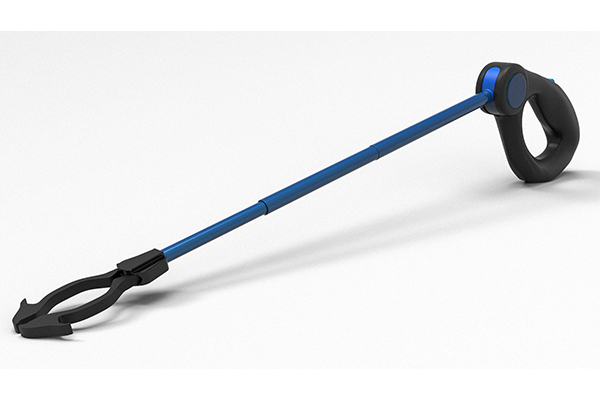 Reacher design by students Armando Ayala and Monique Chabot
Developing assistive technologies for individuals with disabilities is a challenge that requires start-to-finish collaboration between medical professionals, industrial designers and patients. “If something is not properly designed, our clients can’t use it,” says occupational therapist Kim Mollo.
To promote that collaboration, Mollo, along with industrial designers Eric Schneider and Tod Corlett, invited students studying occupational therapy or industrial design to design and develop devices for individuals with fibrodysplasia ossificans progressiva (FOP). FOP is a rare, genetic condition that causes mobility loss as muscles and tendons turn to bone.
The team describes the project, now in its fourth year, in the journal Human Factors in Accessibility and Assistive Technology. For their clinical capstone course, occupational therapy students interviewed FOP patients about their needs and discussed how their current assistive devices could be improved. First-year Master of Science industrial design students then worked to prototype, test, and develop devices that better meet those needs.
To date, the students have designed four assistive devices, the most developed of which is an electromechanical reacher. Traditional reachers allow users to extend their grasp, but their pistol grips require considerable hand strength and the handle orientation cannot be adjusted, something which is critical for use by people with FOP. In the students’ improved design, FOP patients with limited arm mobility can use a finely-tuned electro-mechanical claw with a telescoping and swiveling handle to reach for objects. The dial-controlled claw is accurate enough to “pick up a potato chip without crushing it, and strong enough to lift a full water bottle,” says Schneider.