
Rethinking Architectural ‘Detail’

Architecture professor Eric Bellin traces how a once-vague word came to define design and the built environment at Thomas Jefferson University.

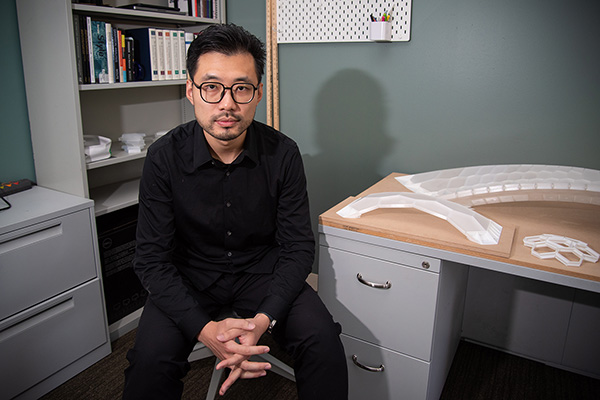
Eric Bellin, PhD, MArch, assistant professor of architecture. Photo Credit: ©Thomas Jefferson University Photography Services

What if one of architecture’s most familiar words didn’t always exist? Today, architects talk endlessly about “details:” the joints where materials meet, the ornaments that catch the eye, the sequences that guide us from street to doorway. But the very idea of architectural “detail” as we now know it is surprisingly new. In fact, before the 19th century, English-speaking architects didn’t use the term in any precise way at all.

Eric Bellin, PhD, MArch, assistant professor of architecture in the College of Architecture & the Built Environment, is interested in studying how the simple word “detail” emerged and shaped a discipline over centuries. As architecture grapples with modern ecological pressures, material shortages and changing social structures, Dr. Bellin hopes that revisiting these sorts of foundational ideas can sharpen how designers think, teach and build.

Find out more about Dr. Bellin’s research and the questions he’s trying to answer.

How would you describe your research to the person riding the elevator with you?

I study histories and theories of building technology and design education, often focusing on the language we use to describe what we do and how that language shapes practice.

This is reflected in my recent book, Detailing Worlds, which examines the history of  architectural “detail,” a concept commonly associated with things like ornamentation, material connections and many other “parts” of larger “wholes.” The word detail is used so commonly in discussions of building that we often take its meaning for granted. It is hard to imagine a time when it was not part of an architect’s vocabulary. My book, however, shows how our notion of “detail” in architecture emerged slowly over the 18th and 19th centuries, taking on different meanings and roles in the work of architects, engineers and builders. For example, the word can refer to nearly any part of a larger whole — from ornamentation or material connections to an entire staircase within a house, an entry sequence connecting a building to the street, or even a waterfront park as a detail within a broader territory. 

What’s a unique fact or a surprising statistic you’ve learned about detail in architecture?

People are often shocked when I tell them that before the 19th century, the word “detail” had no specific meaning in the work of English-speaking architects. Because the “details” we draw and build are so essential to architectural practice today — and because a general notion of “architectural detail” is firmly present in the public consciousness — it can be striking to learn that the very idea of “architectural detail” is relatively recent, emerging only in the last two centuries despite thousands of years of recorded architectural history.   

Why is understanding architectural detail important?

Architectural practice is struggling to respond thoughtfully to contemporary challenges such as social isolation, resource scarcity and the effects of climate change. My research isn’t about any one of these issues, specifically, but about the kind of design thinking that can be brought to bear on such challenges. I believe that a deeper understanding of the thought processes and practices that underlie architectural design can help us produce more vibrant, resilient and interconnected environments. By historicizing and rethinking ideas that are central to our discipline — such as “detail” — my work aims to support more reflective forms of both practice and teaching that better respond to today’s material, social and ecological realities.

What first sparked your interest in your area of study?

As an undergraduate architecture student, I found myself drawn to particular sorts of buildings but struggled to articulate what they held in common. Through independent coursework with the analytical philosopher Kirk Ludwig, I was able to sharpen my thinking. Working with him helped me recognize that the architecture I was drawn to prioritized craft, materiality, human experience and social interaction, as well as the relationships between these things and their broader environments. Architectural detail, as I came to understand it, sat at the nexus of these concerns.  

You also teach in addition to your research. What is your best memory from teaching?

I primarily teach first-year design courses, where I work closely with individual students and help guide them in their first steps toward becoming professional designers.

One moment that stayed with me happened while working with a student who was taking a first-year design course for the second time, after having failed it the previous year. Near the end of the semester, the student walked into the classroom with a stunningly beautiful project, a physical model they’d made — the product of weeks of sustained effort — and their face was absolutely beaming with pride.

When you invest so much time in helping students learn, grow and gain confidence, moments like that, when the impact of teaching becomes tangible, are deeply meaningful and what I love most about my work.

Who’s a role model or someone who shaped your journey?

I’ve been fortunate to have many inspiring teachers and colleagues throughout my career, but three stand out as especially formative mentors. At the University of Florida, Nina Hofer, one of the most dedicated educators I have known, was instrumental in setting me on the path to becoming both a scholar and a teacher. At the University of Pennsylvania, I worked closely with Marion Weiss, a disciplinary leader and visionary architect, whose confidence in me deeply shaped the trajectory of my career. I also owe much to Penn’s Franca Trubiano, who taught me how to ask better questions and pursue more nuanced answers.

Is there a piece of advice that stuck with you that you try to pass on to young researchers?

Serious research requires deep, sustained immersion in a body of material, so it’s important to work on questions that truly interest you and continue to bring you joy.

Share This